
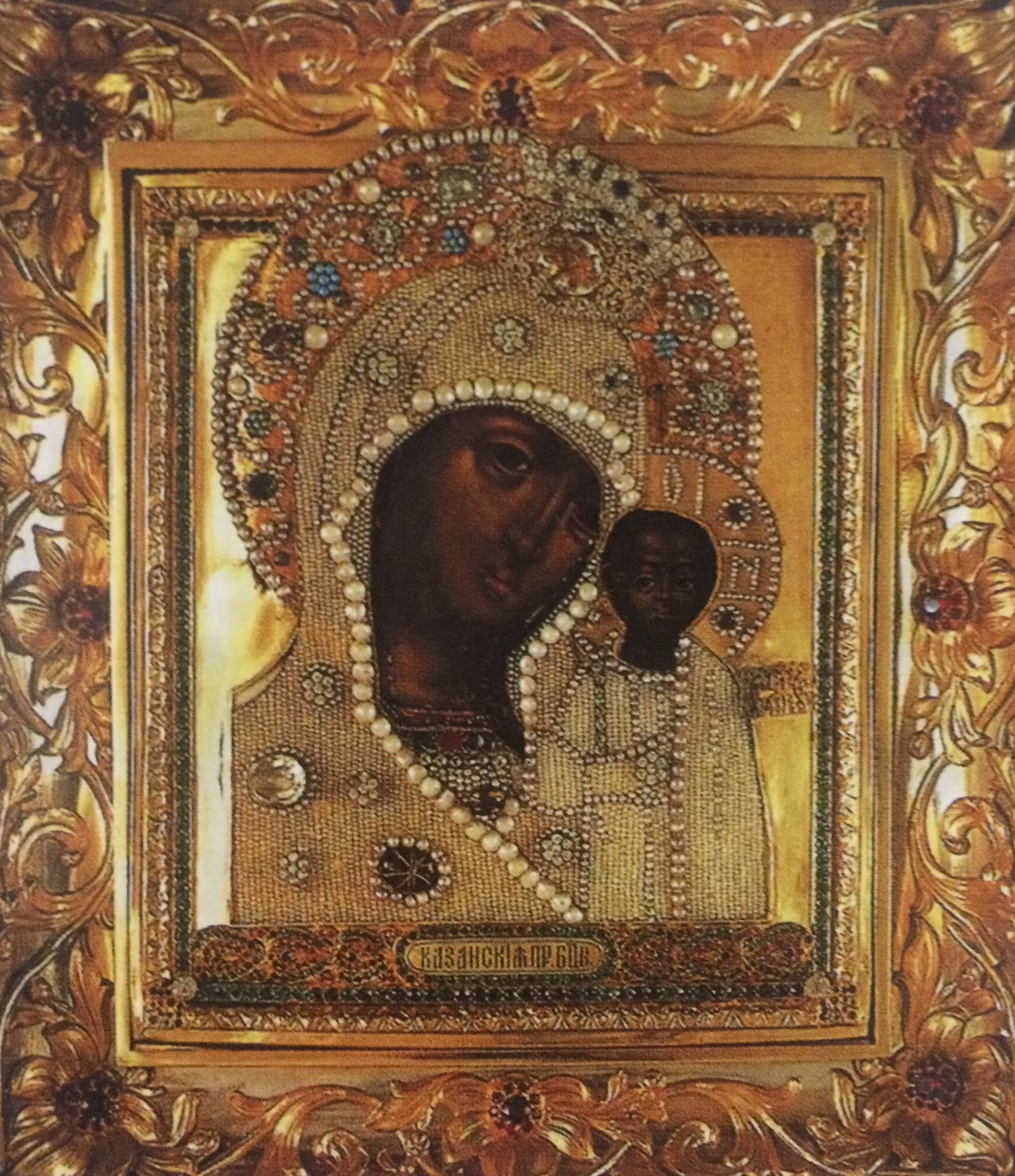
The Kazan Icon of the Mother of God was found buried in the ashes of a fire at Kazan on July 8, 1579, by a nine-year-old girl named Matrona who reported a vision of the Virgin directing her to the spot. It became the palladium of Russia — the icon-image around which the nation's identity as an Orthodox Christian people was organized.
In November 1612, a copy of the icon was carried at the head of the volunteer army of Prince Dmitry Pozharsky and Kuzma Minin as they liberated Moscow from Polish forces, ending the Time of Troubles. In 1812, another copy accompanied Field Marshal Kutuzov as he pursued Napoleon out of Russia — the Grande Armée's disastrous retreat is popularly attributed to her intercession.
During the German advance on Moscow in November 1941, Metropolitan Ilya Karam of the Antiochian Orthodox Church reported a vision instructing that the Kazan icon be carried by aircraft around the city. Marshal Georgy Zhukov is variously credited with ordering the flight; the account is contested by historians but firmly held in Russian devotion. The original icon was stolen and reportedly destroyed by Feodor Chaikin in 1904; the modern icon returned by Pope John Paul II in 2004 and enshrined at Kazan Cathedral in Kazan is one of the sixteenth-century copies.