
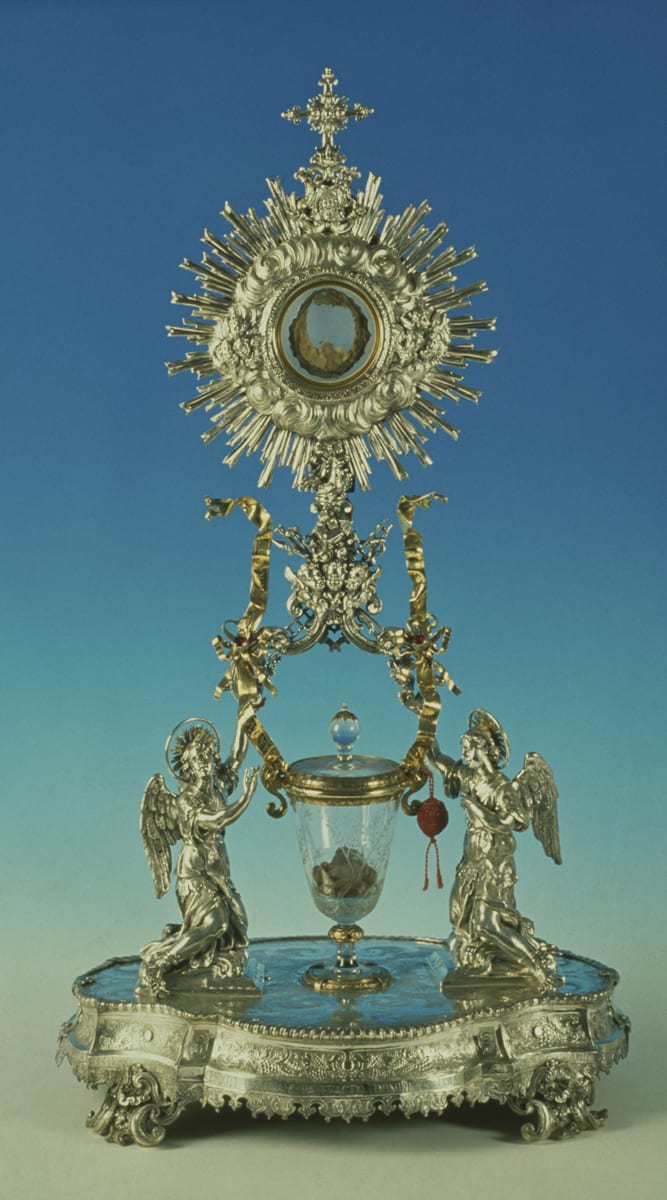
In a Church in Lanciano, on the Adriatic coast of central Italy, a Basilian monk celebrating Mass was tormented by doubts about the Real Presence of Christ in the Eucharist. At the moment of consecration, the host in his hands became visible flesh, and the wine in the chalice became visible blood, which separated into five coagulated globules of unequal size.
The flesh and the five globules of blood were placed in a reliquary and have remained, without any preservative treatment, for nearly thirteen centuries. They are still venerated in the Church of San Francesco in Lanciano.
In 1970–71, with Vatican authorization, Professor Odoardo Linoli — head of pathological anatomy at the Hospital of Arezzo — examined the relics together with Professor Ruggero Bertelli of the University of Siena. Their findings, presented on March 4, 1971, identified the flesh as human cardiac tissue (myocardium of the heart wall, with identifiable arteries, veins, a branch of the vagus nerve, and adipose tissue); the blood as human, type AB, with the protein distribution of fresh blood; and no preservatives of any kind.
A caution, since this site does not repeat claims it cannot stand behind: many popular accounts state that in 1976 a commission of the World Health Organization and the United Nations ran some five hundred further tests and confirmed the miracle. No such study exists. In 2016 the Italian cardiologist Dr. Franco Serafini examined the document itself at Lanciano and found that its contents concerned unrelated tests on Egyptian mummies, with the first and last pages forged to make it appear to be a report on the relics. The genuine scientific work on Lanciano is Linoli's, described above.