
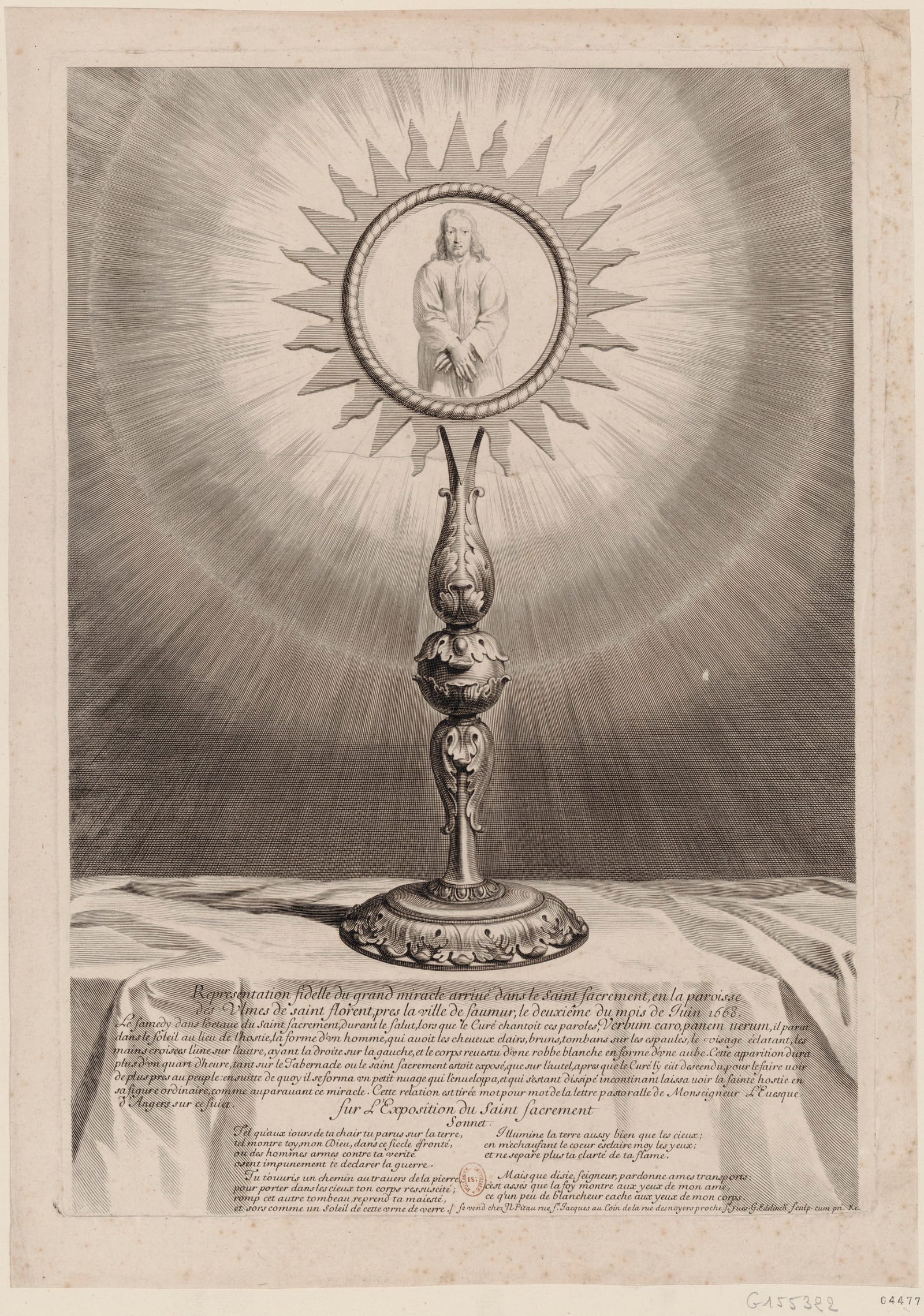
On the evening of Saturday 2 June 1668, at about seven o'clock, the Blessed Sacrament was exposed for adoration in the small parish church of Les Ulmes in Anjou, a few miles south of Saumur. The curé, Nicolas Nézan, had begun to incense the monstrance while the people sang the Pange Lingua. At the verse "Verbum caro, panem verum," the bishop's letter records, "the shape of a man appeared in the monstrance in place of the Host": light-brown hair falling to the shoulders, a luminous face, the hands crossed one over the other, the body clothed in a white tunic like an alb. Witnesses described the features of a young man of about twenty-five. The curé cried out to any unbeliever present to come close, "for here is Our Lord showing Himself visibly," and carried the monstrance down to the altar so that all could see.
The apparition lasted more than a quarter of an hour, both on the throne of exposition and on the altar, before some two hundred people. Nézan wrote at once to his bishop, Henri Arnauld of Angers, who ordered an inquiry and on 20 June came to Les Ulmes himself — on foot rather than by carriage. Convinced, he published a pastoral letter on 25 June 1668 containing a "faithful description" of the event, and returned to the parish on 16 November. He had the account spread by the press: engravings were commissioned from Gérard Edelinck in Paris, from Jean Bidault of Saumur and from a third printer, and the Dominican theologian Jean-Baptiste Gonet discussed the miracle in his Clypeus theologiae thomisticae of 1669. An English translation of the bishop's letter circulated the same year.
The miraculous host was enclosed in a silver monstrance and set in a niche of red marble cut into the wall of the choir, where pilgrims adored it for some 130 years; the recess can still be seen. In 1794, fearing profanation, a priest carried it to neighbouring Le Puy-Notre-Dame; the exhibition panel says it was there devoutly consumed during the Revolution, while a local account holds it was recovered in 1833 and then consumed by the curé at the bishop's order. The anniversary was kept solemnly into the eighteenth century, and the miracle was studied at the International Eucharistic Congress of Angers in 1901 and in a full session of the 1933 National Eucharistic Congress. Historians note that Arnauld, a bishop of Jansenist sympathies, nonetheless embraced a vision that answered the age's longing to see the host — a sign for some and a provocation for others.