
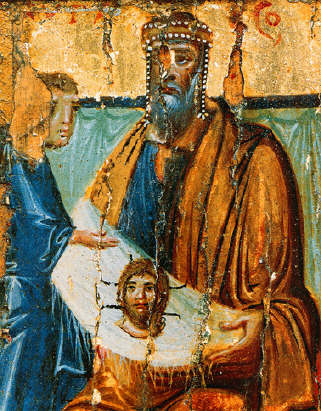
Tradition holds that the Mandylion (Greek: μανδύλιον, 'little towel') is a cloth bearing the face of Christ, imprinted not by human hand but by Christ Himself, who pressed His face to the linen at the request of King Abgar V of Edessa. The image is described in the earliest sources as 'acheiropoietos' — 'made without hands.'
The Mandylion was preserved at Edessa from the first century. During the Persian siege of 544, the city's defenders carried it in procession around the walls and the siege was lifted; the Byzantine historian Evagrius Scholasticus (writing c. 593) recounts this as an established miracle. Over the following centuries the cloth became the most venerated icon in the Christian East.
In 944, the Byzantine Emperor Romanus I Lecapenus secured the Mandylion from the Muslim emir of Edessa and brought it in solemn procession to Constantinople, where it was enshrined in the Pharos Chapel of the Imperial Palace. The Feast of the Translation of the Mandylion (August 16) entered the calendar of the Eastern Church and is celebrated to this day.
When Constantinople fell to the Latin Crusaders of the Fourth Crusade in 1204, the relic disappeared from the historical record. Multiple scholars — notably Ian Wilson in 'The Shroud of Turin' (1978) — have argued from the medieval iconography and the physical evidence that the Mandylion is identical with the full burial cloth now venerated at Turin: folded so that only the face was visible, it was reverenced as the Mandylion until 1204; unfolded after its appearance in the West, it revealed the full image of the crucified Christ and became known as the Shroud.