
By the ancient Mantuan tradition, the centurion who pierced the side of Christ at Calvary — Longinus — was converted at the moment the blood and water flowed onto him, and took two vessels of the Holy Blood with him on his subsequent missionary journeys, eventually arriving at Mantua, where he was martyred under Nero. He buried the vials at the place of his martyrdom.
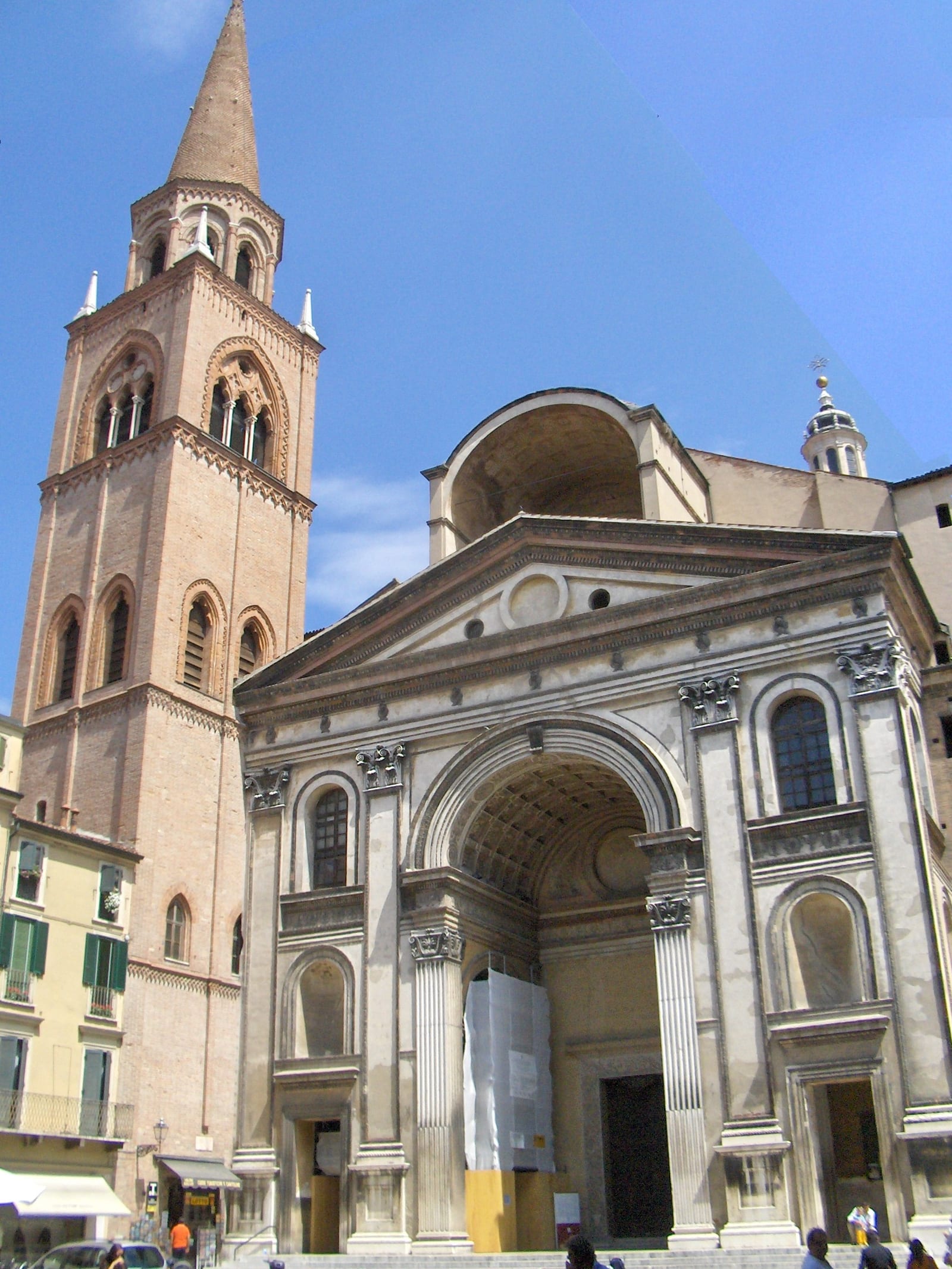
The relic was rediscovered in AD 804, examined by Pope Leo III, and venerated at the church built on the site. Lost again during the Hungarian invasions, it was rediscovered a second time in 1048 in the presence of Pope Leo IX, Mathilda of Tuscany, and Emperor Henry III, in two great vials. Half of the relic was sent in 1094 by Mathilda to her cousin Welf of Bavaria (the foundation of the Holy Blood of Weingarten — see that entry); half remained at Mantua. The great Basilica of Sant'Andrea, designed by Leon Battista Alberti and begun 1472, was built specifically to house the Mantuan portion. The relic is exposed each year on Good Friday in the Sacri Vasi, two precious crystal-and-gold reliquaries kept beneath the altar.