
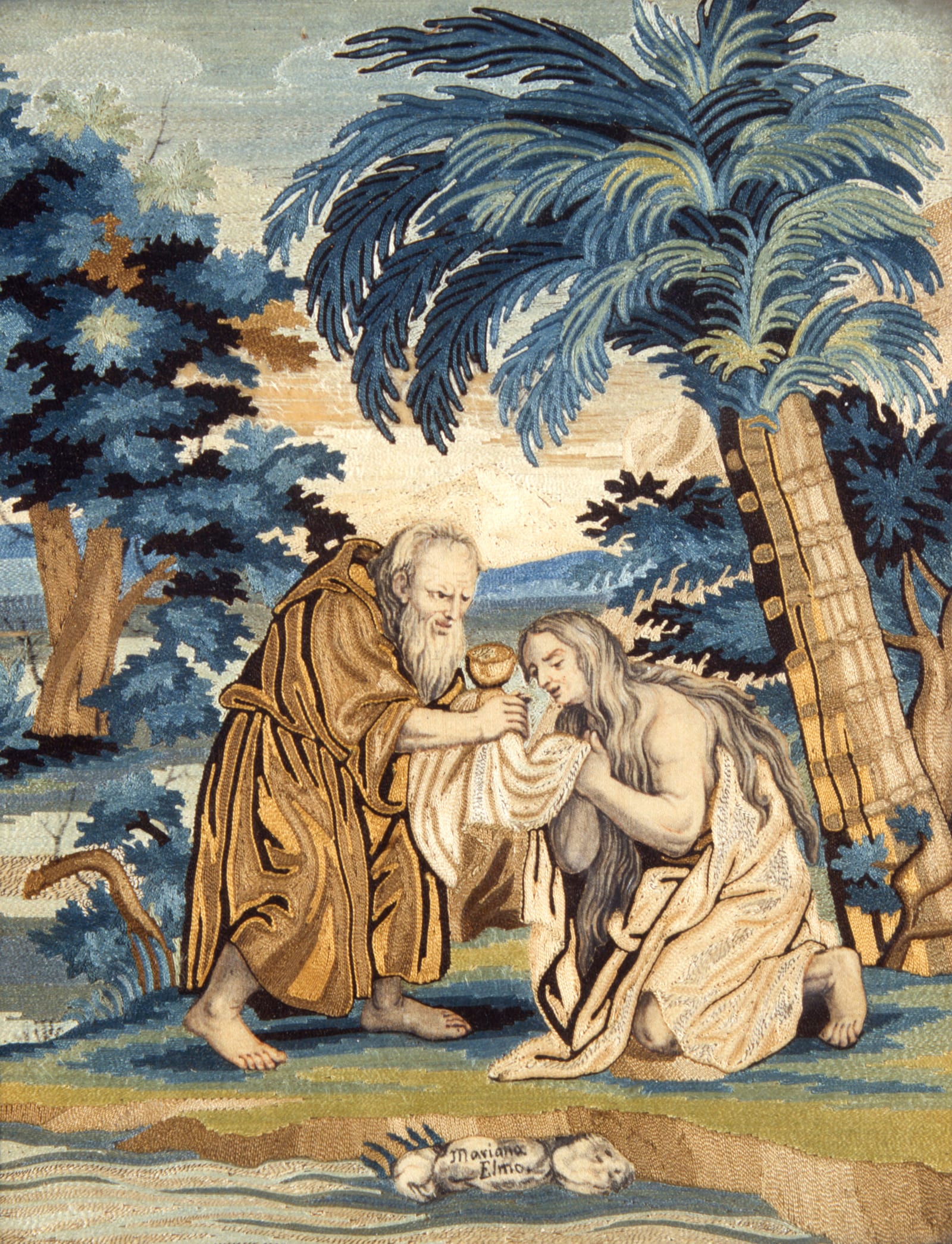
The Life of St. Mary of Egypt, traditionally ascribed to St. Sophronius, Patriarch of Jerusalem (d. 638), though the Bollandists argued it was written before 500 from the recollections of the monks of Zosimas's own monastery, tells of a girl who left her parents at twelve for Alexandria and lived seventeen years in dissipation. Joining a pilgrimage to Jerusalem for the Exaltation of the Holy Cross, she found herself held back by an unseen force at the door of the Holy Sepulchre. Before an icon of the Mother of God she begged forgiveness, was able to enter and venerate the Cross, and heard a voice: "If you cross the Jordan, you will find glorious rest." At the monastery of St. John the Baptist on the river bank she confessed, received Communion, and walked into the desert with three loaves.
Forty-seven years later the priest-monk Zosimas of Palestine, keeping Lent in the wilderness after the custom of his community, met a sun-blackened figure who called him by name and, after borrowing his cloak, told him her story. She asked him to return the following year, on Holy Thursday evening, to the bank of the Jordan with the Blessed Sacrament. Zosimas came; and as he waited in anguish, Mary appeared on the far shore, made the sign of the Cross over the water and walked across it as on dry ground. She received the Body and Blood of Christ, prayed Simeon's Nunc dimittis, and asked him to come again the next year.
When Zosimas returned he found her body lying as if asleep, with a message traced in the sand: she had died the very night of her Communion. A lion came out of the desert and helped him dig her grave. The Bollandists place her death on 1 April 421; other authorities set it a century later. The Life was read into the acts of the Second Council of Nicaea (787) and remains the great Lenten reading of the East. The Church keeps her feast on 1 April (2 April in the older Roman calendar); the Byzantine rite also honours her on the fifth Sunday of Great Lent. Her relics are venerated at Naples, Sens, Florence and elsewhere. The Vatican exhibition lists her story as the earliest of its Eucharistic miracles: no bleeding host, but a soul drawn across a river to receive Him.