
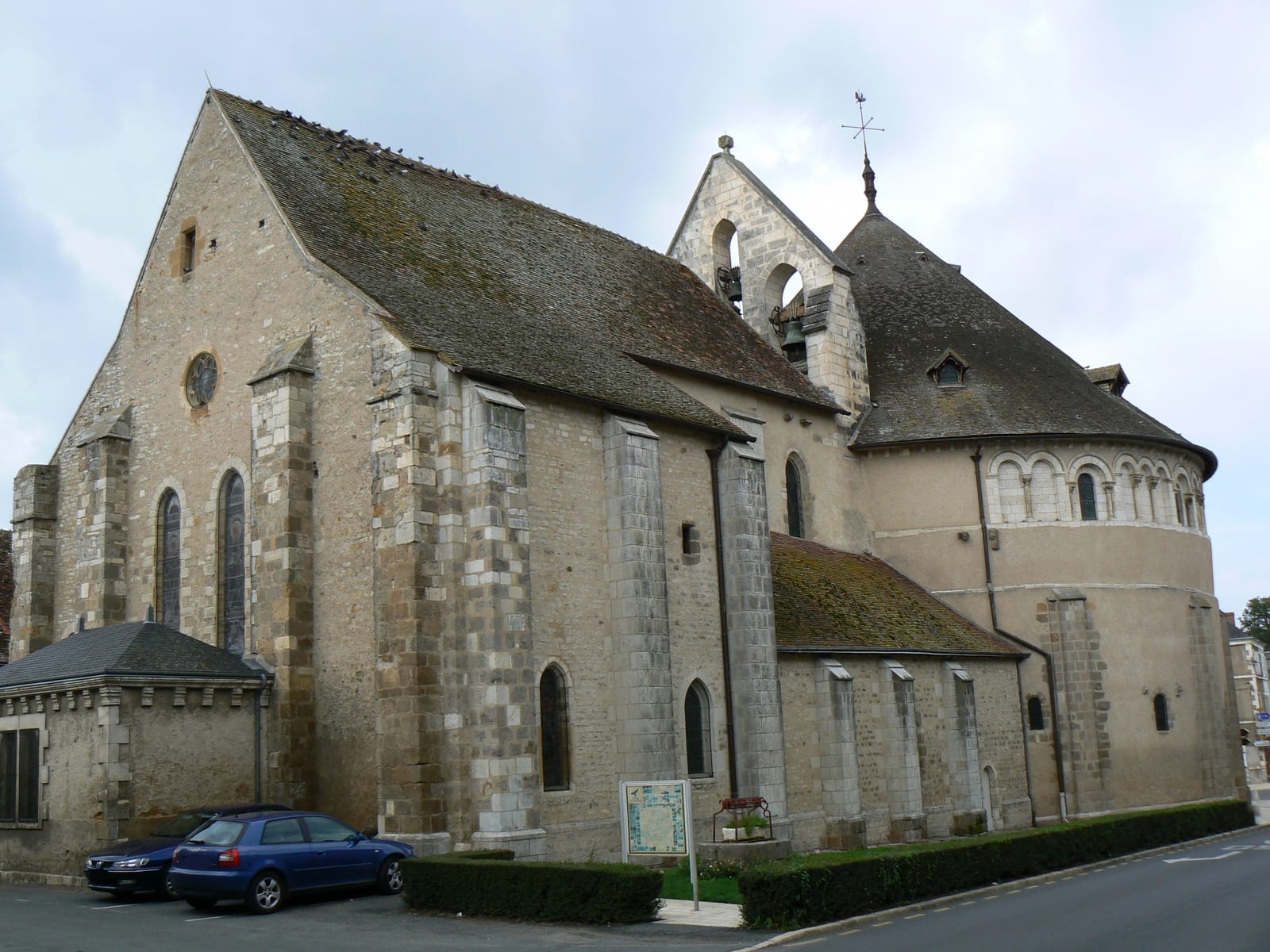
Around 1045 the lord Eudes de Déols, home from pilgrimage to Jerusalem, founded at Neuvy a church built to the plan of the Anastasis rotunda of the Holy Sepulchre: a circular chamber 22 metres across and 16 high, carried on eleven columns for the eleven Apostles who remained after Judas, with an ambulatory and capitals carved with the struggle of good and evil. It is the most faithful surviving imitation of the Holy Sepulchre in France. The collegiate church, first dedicated to St. James the Greater, stood on the road to Compostela; in 1847 it became the parish church of Saint-Étienne, Pius X raised it to a minor basilica on 23 November 1910, and in 1998 it was inscribed by UNESCO among the monuments of the Way of St. James.
In 1257 Cardinal Eudes de Châteauroux, bishop of Tusculum, papal legate on the first crusade of St. Louis and a native of the Berry, sent to Neuvy two relics from the Holy Land where he had spent six years: a fragment of the stone of Christ's tomb, and two small coagulated drops, described in the tradition as the Blood shed on Calvary, unmixed with water or earth, and thus, in the words of the exhibition panel, "known to be pure." The cardinal asked that they be exposed only on Good Friday and on the Sunday before St. Denis. They were kept in a reliquary at the centre of the rotunda until 1806.
The relic gathered its own history. In 1621, when the Bouzanne threatened to flood the town, the inhabitants begged the canons to bring it out, and the chronicle records that the waters receded; a Confraternity of the Most Precious Blood was founded that year under André Frémyot, Archbishop of Bourges, and Gregory XV granted indulgences to it in 1623. During the Revolution the sacristan Jean Blondeau hid the drops, replacing them with pieces of cooked pear until it was safe. The Church has never pronounced on the relic's origin beyond the devotion it has authorised; what is certain is seven centuries of pilgrimage. The Easter Monday procession of the Precious Blood, with the diocesan clergy and Knights of the Holy Sepulchre, still draws several hundred to a thousand pilgrims, and the Acutis exhibition shares its Neuvy panel with the cure of La Rochelle.