
In October 1717 the Count of Assumar — Governor of São Paulo and Minas Gerais — was making an official visit to Guaratinguetá, and the local fishermen were ordered to provide fish for the banquet to be held in his honour. Three of them — Domingos Garcia, João Alves and Filipe Pedroso — set out on the swollen Paraíba do Sul, which was running too high for good fishing. They cast their nets all day with no catch.
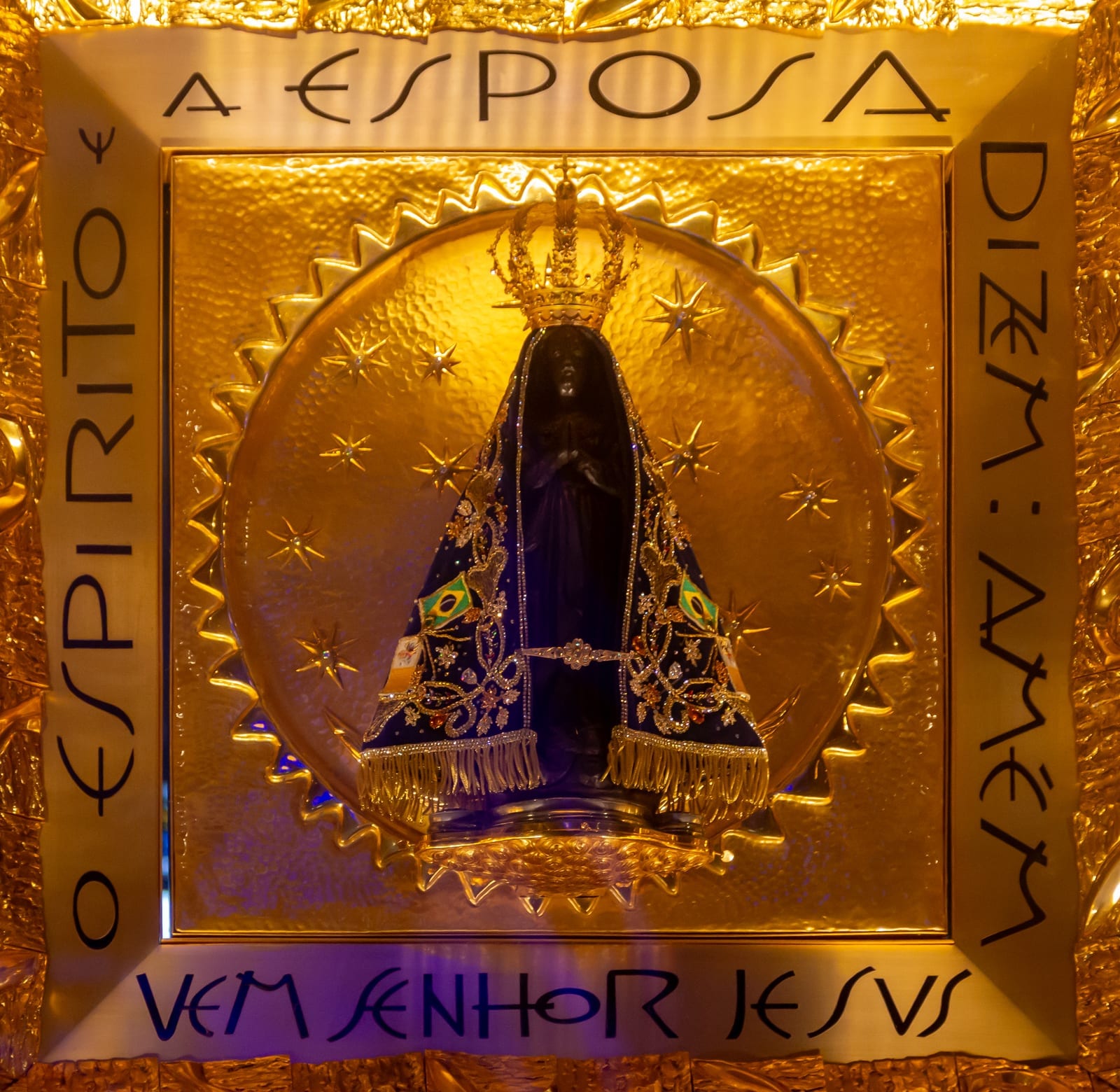
On a final cast, before turning home in disgrace, Filipe Pedroso pulled up something heavy: the headless body of a small terracotta statue of the Virgin Mary, some 40 cm tall, blackened by long submersion. He laid it in the boat and cast again; this time he pulled up the head. He fitted the pieces together, prayed before the statue, and cast the net one more time. The boat filled to overflowing with fish.
The fishermen brought the statue home, and the cult began modestly in Pedroso's house before spreading through the region. The miracles reported around the image drew such crowds that a chapel was built in 1745; the old basilica replaced it from 1834; the present basilica was begun in 1955. Pope Pius XI proclaimed Our Lady Aparecida principal patroness of Brazil on 16 May 1930, and in 1980 John Paul II consecrated the new Basilica of the National Shrine, which today rivals St. Peter's in size and receives more than twelve million pilgrims a year. The original statue occupies the place of honour on the main altar.
Art historians attribute the statue to the Benedictine monk-sculptor Frei Agostinho de Jesus (c. 1650), broken and lost — evidently from a passing boat — decades before the fishermen found it. The miracle is not in its origin but in its providential rediscovery and the devotion of the Brazilian people that followed: one of the most loved Marian images in Latin America. The statue was smashed in an attack on 16 May 1978 and restored; that event has its own entry.