
In the year 1612, three young men — the brothers Rodrigo and Juan de Hoyos, both white Cuban natives, and a small black slave boy from Santiago, Juan Moreno (collectively 'los tres Juanes,' the three Johns) — were sent out by their employers in a small canoe from the village of Barajagua on the Bay of Nipe, on the northeast coast of Cuba, to collect salt at the salt works of nearby Cayo Francés.
A sudden storm overtook them on the open bay. Juan Moreno later testified before the diocesan tribunal that during the storm they saw, in the distance, what looked like a small white bird floating on the waves. As they rowed closer, the white object resolved into a small wooden image of the Blessed Virgin Mary, dressed in white robes, holding the Christ Child in her left arm and a cross of gold in her right hand. The image floated on a small wooden tablet on which was inscribed: 'Yo soy la Virgen de la Caridad' — 'I am the Virgin of Charity.' The image and the tablet were perfectly dry — neither had absorbed a drop of water. The storm immediately ceased.
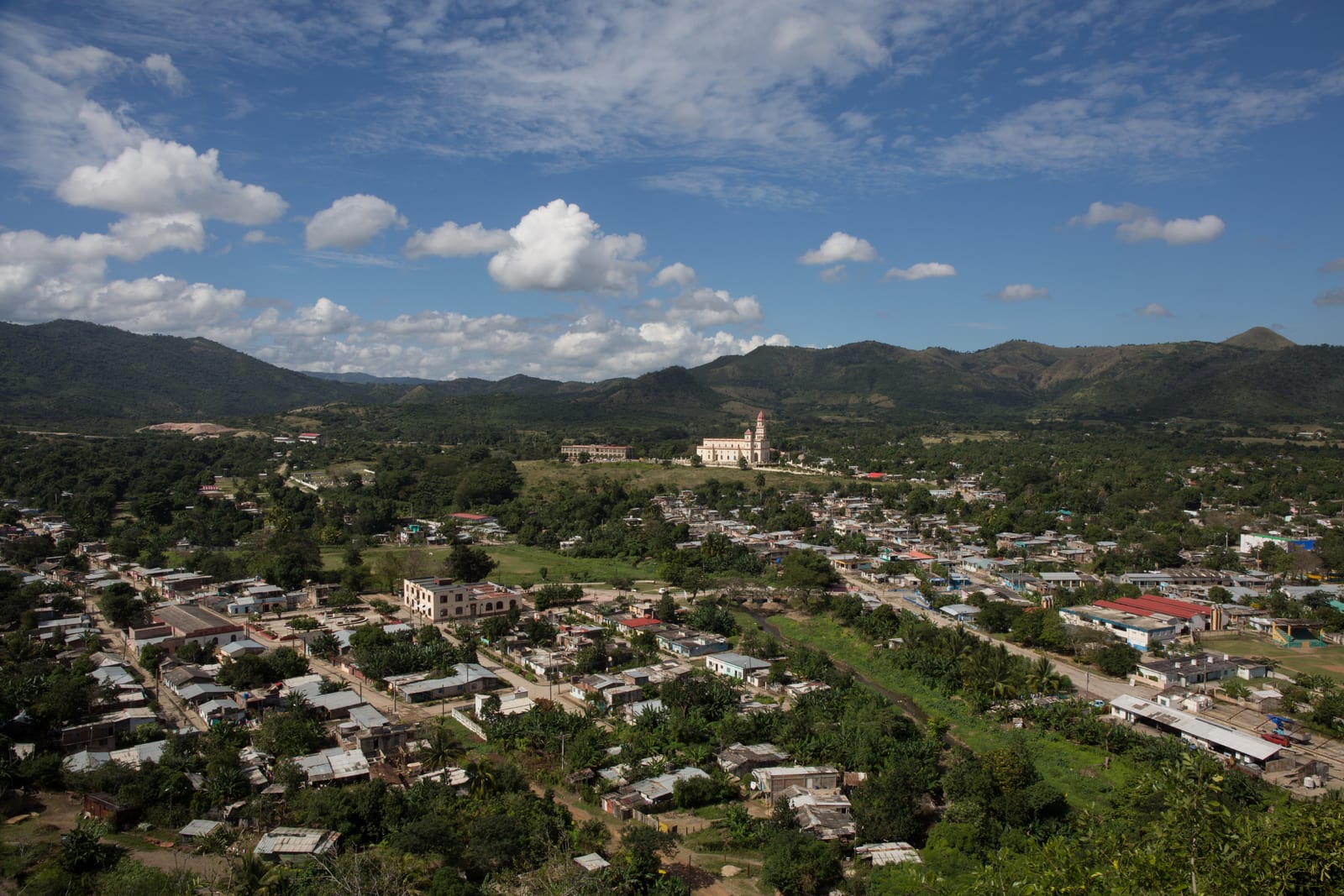
The three brought the image back to Barajagua. It was venerated locally for over a century, then translated to the great copper mining village of El Cobre, near Santiago. The cult spread through Cuba and to the Cuban diaspora. Benedict XV declared her Patroness of Cuba in 1916, at the request of the veterans of the Cuban War of Independence. John Paul II canonically crowned her in 1998 during his visit to the island. The original 16-inch wooden statue still rests in the Basilica of Our Lady of Charity at El Cobre.