
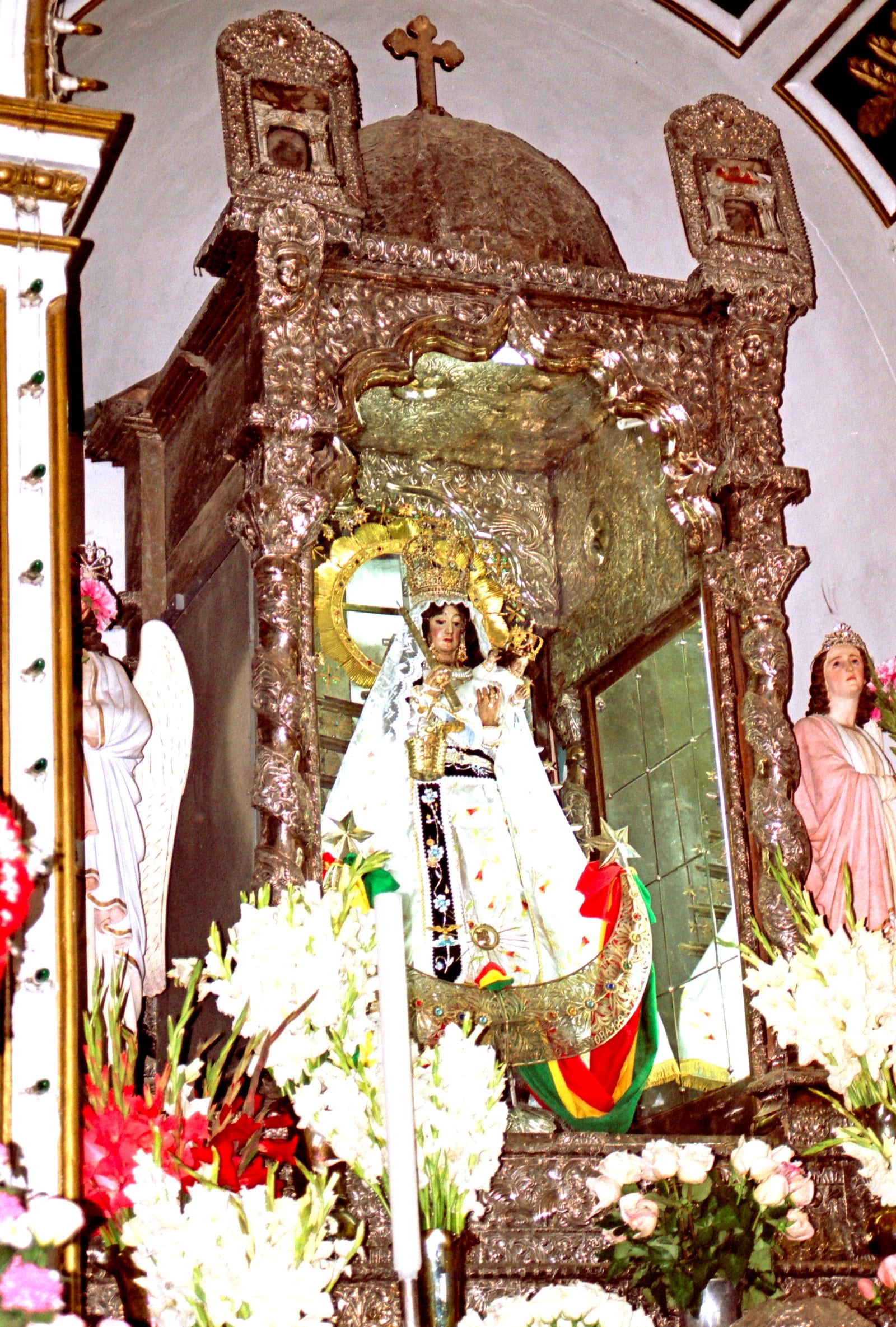
Francisco Tito Yupanqui (c. 1550 – 1616), a young Aymara man descended from Huayna Capac the eleventh Sapa Inca, was born in the colonial mining region of Bolivia and converted to Christianity. With his brother and several companions in the small village of Copacabana on the southern shore of Lake Titicaca, he wished to give the village a worthy image of the Blessed Virgin Mary — the previous one being only a poor clay figure.
Knowing nothing of sculpture, Francisco walked the more than 800 kilometers to Potosí — the great silver-mining city — to learn the art. The Spanish artists refused to teach him; one priest called his work 'a monkey's labor.' He labored through repeated failures, frequently in tears. At last, in the workshop of an indigenous master named Diego Ortiz, he completed a statue of the Virgin holding the Christ Child, carved from the maguey wood of his native highlands, plated with gold, the figure roughly four feet tall.
He carried it on his shoulders back through the high passes to Copacabana. On the Feast of the Purification (Candlemas), February 2, 1583, the statue was enshrined in the village chapel. From the first day pilgrims reported healings of body and soul; the cult spread first through the Aymara villages of the altiplano, then through the whole viceroyalty of Peru, and across Spanish America. Devotion to Our Lady of Copacabana was carried by indigenous and Spanish migrants north to Mexico, west across the Pacific, and east to Brazil, where the famous Rio de Janeiro neighborhood and beach take their name from her.
Pius XI canonically crowned the statue in 1925 and declared her Queen of Bolivia. Pope Francis venerated her image during his 2015 visit to Bolivia. The shrine at Copacabana, on the shores of the highest navigable lake in the world (3,841 meters), is one of the great Marian pilgrimage centers of South America.