
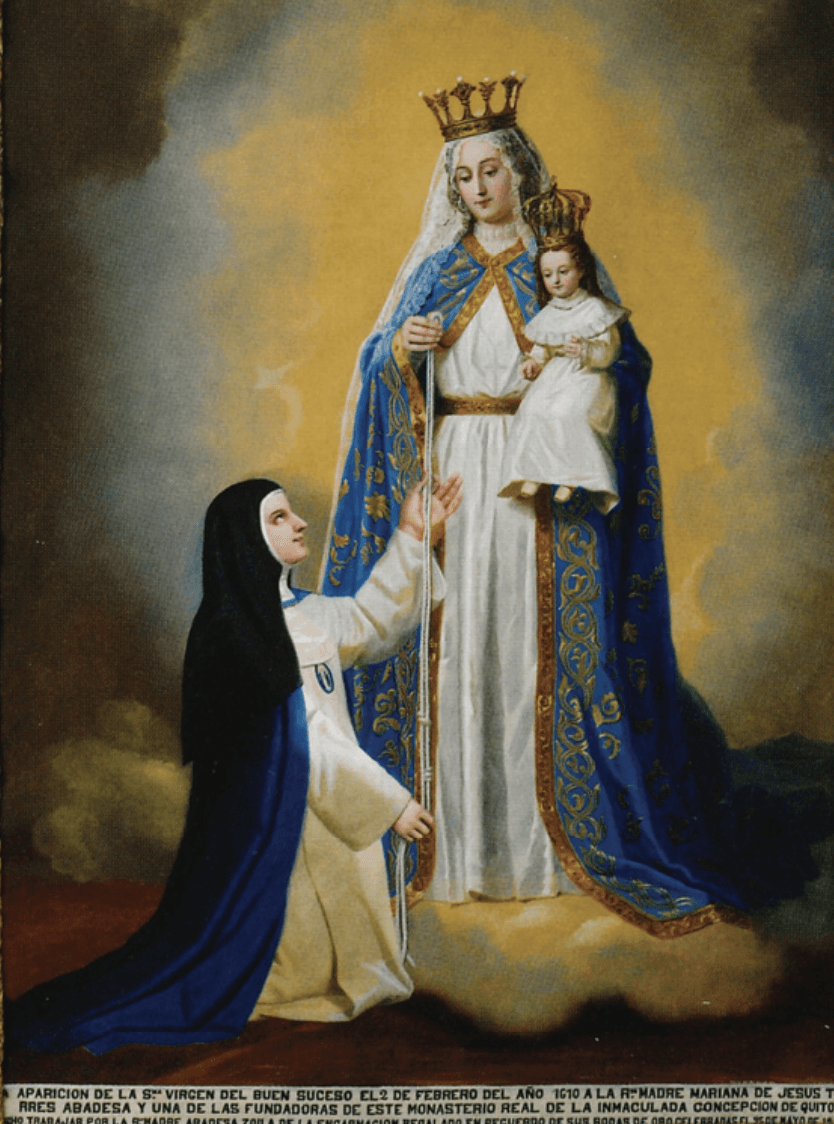
Mother Mariana de Jesús Torres y Berriochoa (1563–1635), a Spanish Conceptionist nun, was among the founding sisters of the Royal Convent of the Immaculate Conception in Quito, then the capital of the Real Audiencia. The Virgin, appearing under the title 'Nuestra Señora del Buen Suceso' (Our Lady of Good Success), gave Mother Mariana detailed prophecies about a coming age of crisis in the Church — often dated by traditional readings to the mid-twentieth century.
In 1610, the Virgin asked that a statue be sculpted to her likeness. Francisco del Castillo, the leading sculptor of colonial Quito, spent months on the piece and remained unsatisfied. According to the convent chronicle, he awoke one morning to find the statue finished — the details of the face, the crown, and the crozier completed overnight by hands that were not his. The statue is the same one venerated at Quito today.
The apparitions and the statue received local approval from Bishop Salvador de Ribera in 1611. The convent remains closed to public tours; the statue is displayed on request in the upper choir where Mother Mariana lived and died. The Archdiocese of Quito opened her cause in 1984 and set up a diocesan tribunal in 1986; the devotional literature calls her Venerable on the strength of a 1968 decree of the Archbishop of Quito, but no decree of heroic virtues has come from Rome, so her title in the Church's own reckoning is Servant of God. The detailed prophecies about the twentieth century come not from her century but from <em>The Admirable Life of Mother Mariana de Jesús Torres</em>, written by the Franciscan provincial Manuel de Souza Pereira and published in 1790 — a hundred and fifty-five years after her death, and not what Bishop Ribera approved in 1611.