
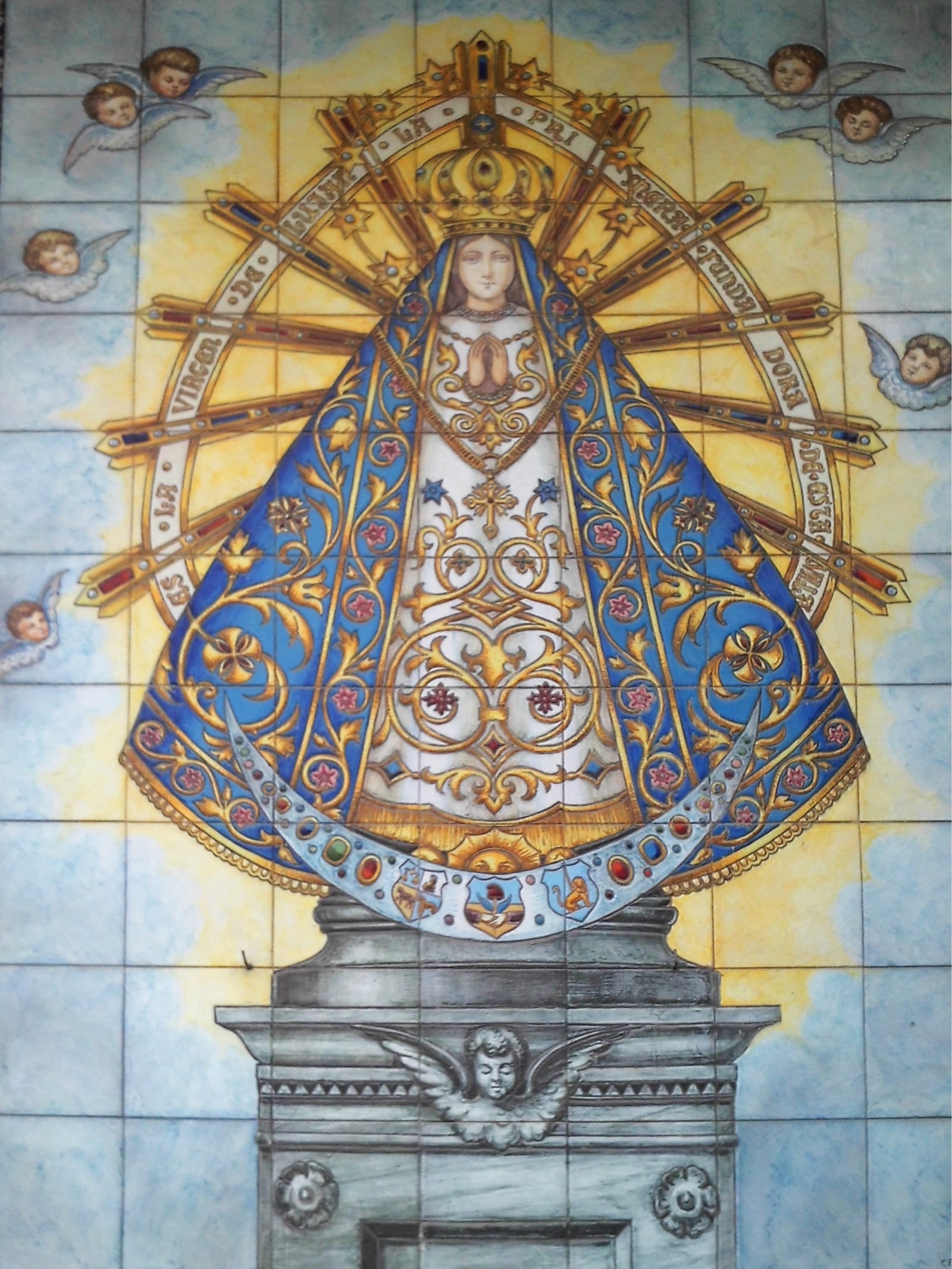
Around 1630, a Portuguese settler named Antonio Faríaz de Sá living near present-day Sumampa in the modern Argentine province of Santiago del Estero wrote to a friend in Pernambuco, Brazil, asking him to send a statue of the Immaculate Conception for the chapel he was building. The friend, unsure which form would please most, sent two: one larger, representing the Immaculate Conception; one smaller, representing the Mother of God in another form.
The statues were shipped to Buenos Aires, then loaded onto an oxcart for the long overland journey to Sumampa. The cart reached the Luján River, in the Argentine pampas, and there the oxen — strong, well-rested, well-fed — refused to pull further. The drivers tried every device: nothing moved them. Suspecting that something was wrong with the load, they unloaded the boxes one by one. The cart would move only after the smaller statue, the Immaculate Conception, was set aside; the moment it was lifted from the cart, the oxen pulled freely.
The drivers, recognizing this as a sign that the Virgin wished to remain at the spot, left the small statue at the house of a settler, Don Rosendo, on the bank of the Luján River. The cart and the other statue continued unmolested to Sumampa. The chapel of Don Rosendo became a pilgrimage site; the original statue, now over four hundred years old, has been venerated continuously and is enshrined in the great Basilica of Luján completed in 1937.
Pope Leo XIII gave her solemn canonical coronation in 1887. Pius XI declared her Patroness of Argentina, Uruguay, and Paraguay in 1930. The Basilica of Luján is the largest Catholic church in South America by area and the great national shrine of Argentina; pilgrims walk the 67 kilometers from Buenos Aires to Luján each October in a procession that draws hundreds of thousands.