
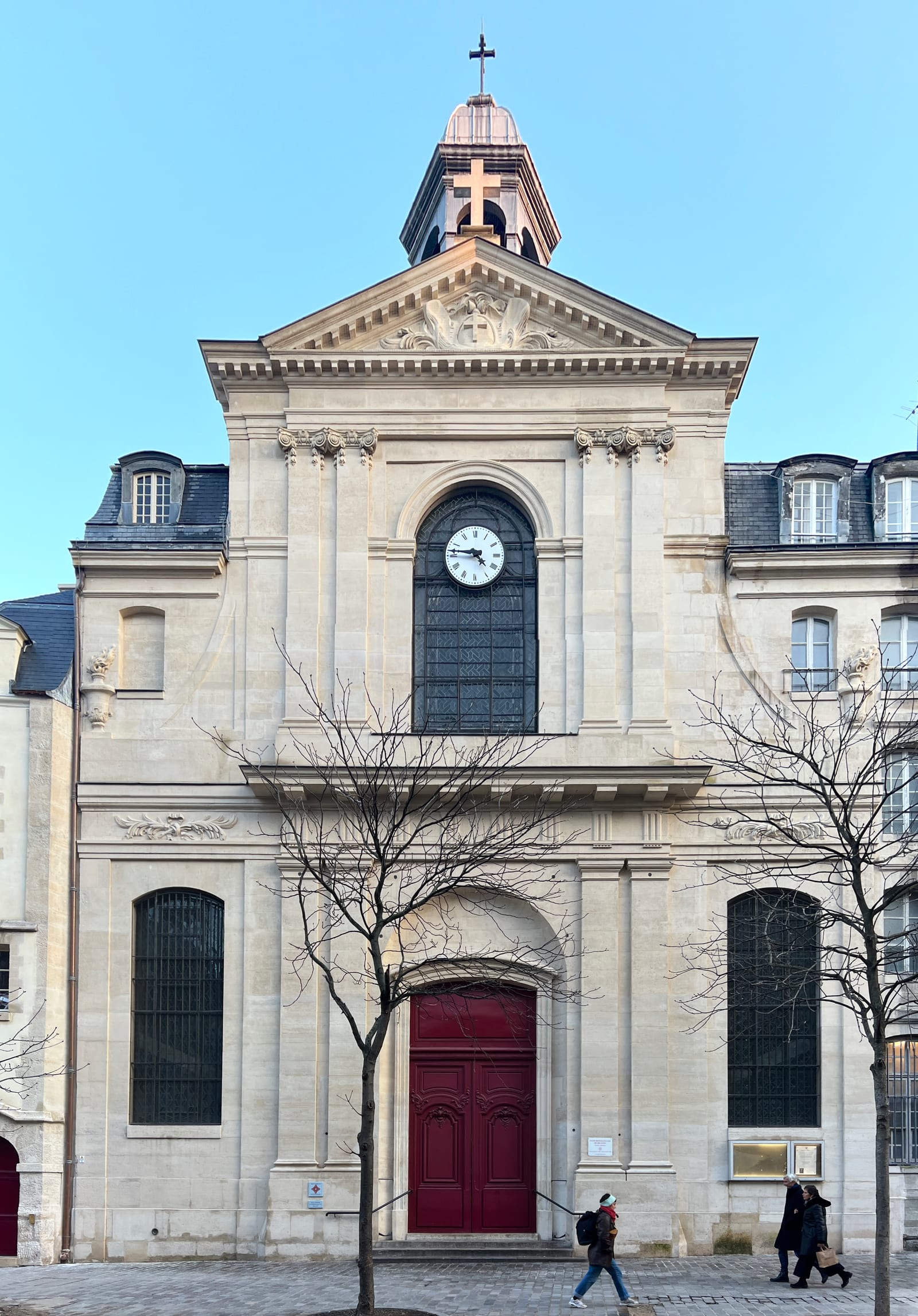
In 1290 a Parisian woman, in desperate need to redeem her cloak from a moneylender named Jonathas before Easter, was reportedly persuaded by him to bring him a consecrated host (which he wanted to test whether the Real Presence was truth). Receiving Communion at her parish, she removed the host and gave it to him. He pierced it repeatedly with a knife; the host bled. He then threw it into a kettle of boiling water; the water turned to blood and a small image of Christ crucified rose from the kettle.
The moneylender confessed the act; he was arrested and executed. The relic was preserved. The site of his house — at what is now the corner of Rue des Archives and Rue des Blancs-Manteaux in the Marais — became the location of the Église des Billettes, the oldest medieval church still standing in central Paris. (Note: as with several Eucharistic miracles involving Jewish neighbours in the medieval period, this narrative was historically used in anti-Jewish polemic; the Church has subsequently rejected such uses.)