
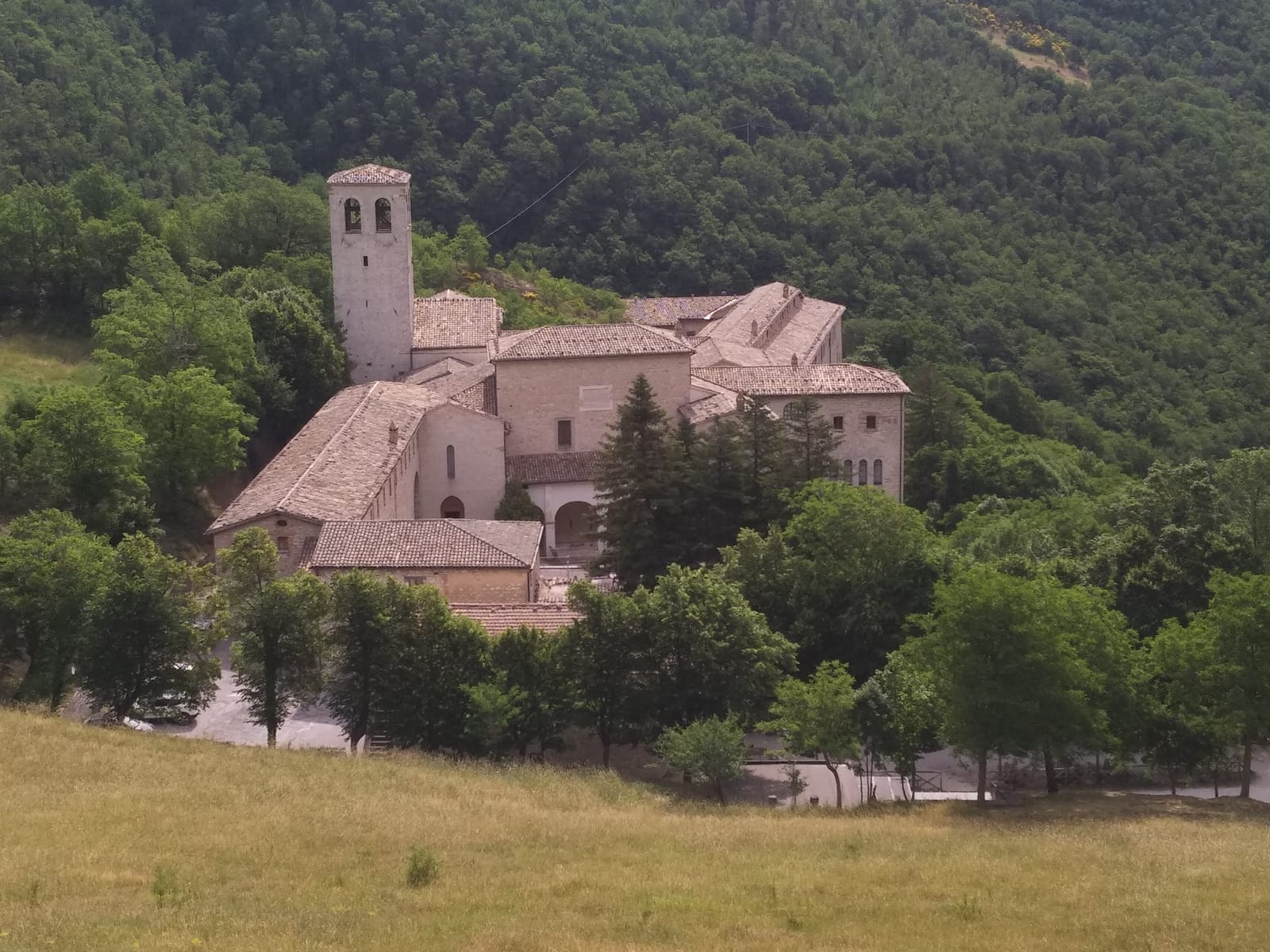
Among the oldest Eucharistic miracles in the Vatican's international exhibition is one that survives not in a shrine but in a text. St. Peter Damian (c. 1007–1072), the Ravenna-born hermit who entered Fonte Avellana around 1035, became its prior in 1043 and was later made cardinal and, in 1828, a Doctor of the Church, described the episode in his Opusculum XXXIV (Patrologia Latina, vol. 145, col. 573). The exhibition panel dates it to about 1050 and presents Peter Damian as a direct witness. The story is brief. A sorceress asked a woman to procure a consecrated Host for her spells. The woman went to Mass, received Communion, and instead of consuming the Host slipped it into a handkerchief or linen cloth to carry home.
The priest noticed the theft and ran after her, demanding that she show what she was hiding. When the cloth was unfolded, half of the Host had been transformed into visible Flesh, while the other half retained the ordinary appearance of bread. Peter Damian draws the lesson explicitly: God allowed one half to show the Body of Christ and the other to keep its natural form so that unbelievers and heretics who denied the Real Presence might be won over, the two halves together displaying the reality of the change that takes place at the consecration. His account belongs to the same eleventh century in which Berengarius of Tours was disputing that very doctrine, which gives the testimony its historical weight.
No relic, church, or town is attached to the account; Peter Damian does not name the place, and the exhibition panel illustrates it with the hermitage of Fonte Avellana, where he lived and wrote. The miracle therefore rests on the written witness of a saint and Doctor of the Church rather than on any later episcopal inquiry, and it is catalogued here in that honest spirit: a trusted voice, a clear claim, and an unnamed village somewhere in eleventh-century Italy. The hermitage itself, founded around 980 and still inhabited by Camaldolese monks, stands on the slopes of Monte Catria in the Marche and is remembered by Dante in the Paradiso.