
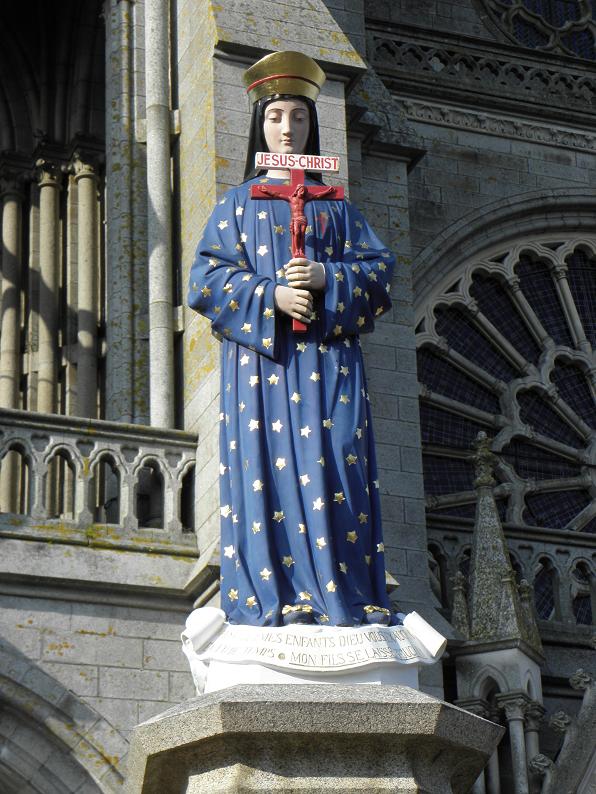
On the evening of January 17, 1871, the Prussian army had reached the Maine river and the citizens of Laval expected to be overrun. In the snow-bound village of Pontmain, twelve-year-old Eugène Barbedette looked out of his father's barn and saw a beautiful Lady in a starry blue robe standing in the night sky above their neighbour's house. His younger brother Joseph saw her too; their parents and neighbours, gathered to look, saw nothing.
Over the next three hours four village children — the Barbedette brothers and two small girls, Françoise Richer and Jeanne-Marie Lebossé — saw the Lady. A white banner unfurled at her feet; letters formed letter by letter to spell, 'Mais priez mes enfants. Dieu vous exaucera en peu de temps. Mon Fils se laisse toucher' — 'But pray, my children. God will answer you in a little while. My Son lets Himself be moved.' She wept; a small red cross with the name 'Jésus-Christ' appeared in her hands; she blessed the village.
That same evening, against military expectation, the Prussian commander General von Schmidt ordered his troops to halt their advance toward Laval. Eleven days later the armistice ending the war was signed. Bishop Wicart of Laval recognised the apparition as authentic on February 2, 1872.