
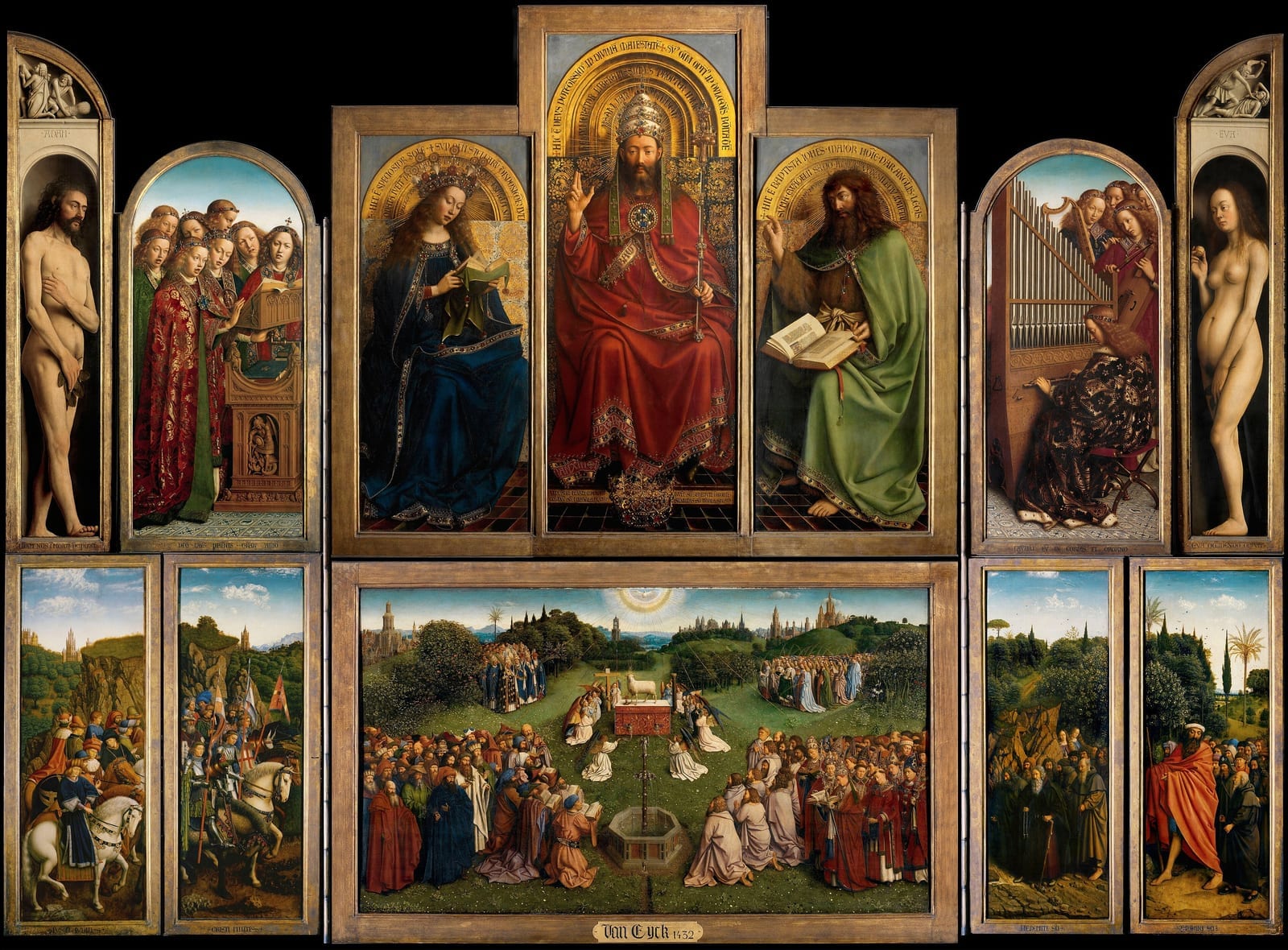
Exiled to the small Aegean island of Patmos under the persecution of Domitian (probably c. AD 95), the aged Apostle John received the great visionary cycle of the Apocalypse. On the Lord's Day, in the Spirit, he heard a voice like a trumpet: 'Write what you see in a book and send it to the seven churches.'
He saw a door opened in heaven and was taken up. He beheld a throne in heaven with one seated upon it whose appearance was like jasper and carnelian, with a rainbow around it like an emerald. Twenty-four elders sat on twenty-four thrones around it, clad in white, golden crowns on their heads. Four living creatures — like a lion, an ox, a man, an eagle — full of eyes before and behind, ceaselessly cried: 'Holy, holy, holy is the Lord God Almighty, who was and is and is to come!'
Then John saw in the right hand of him who sat on the throne a scroll sealed with seven seals. A mighty angel proclaimed: 'Who is worthy to open the scroll and break its seals?' No one in heaven or earth was found worthy. John wept much. One of the elders said: 'Weep not; lo, the Lion of the tribe of Judah, the Root of David, has conquered, so that he can open the scroll and its seven seals.' And John saw, between the throne and the four living creatures, a Lamb standing as though it had been slain. He took the scroll; the elders fell down before him with golden bowls of incense — the prayers of the saints — and a new song: 'Worthy art thou.' The vision is the foundational image of the Eucharistic liturgy of the Catholic, Orthodox, and Anglican traditions.