
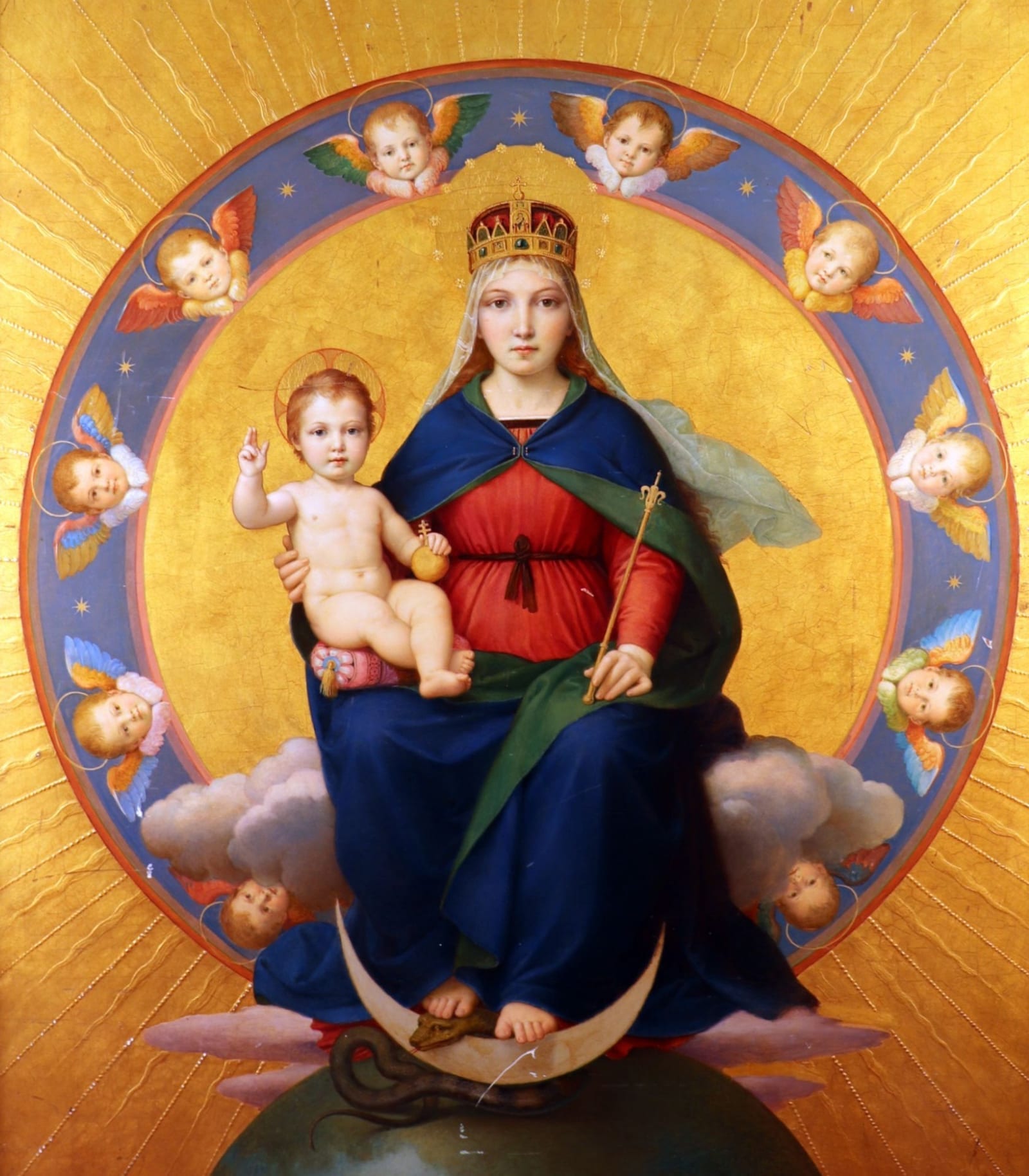
Among the great visions of John's Apocalypse, none has shaped Catholic Marian iconography more than Revelation 12. 'A great sign appeared in heaven: a woman clothed with the sun, with the moon under her feet, and on her head a crown of twelve stars; she was with child, and she cried out in her travail and pangs of birth.'
A great red dragon — seven-headed, ten-horned, seven diadems on his heads — stood before the woman to devour the child as soon as she gave birth. She bore a male child, who was to rule all the nations with a rod of iron; her child was caught up to God and to his throne. The woman fled into the wilderness, where she had a place prepared by God. War broke out in heaven; Michael and his angels fought the dragon. The dragon was cast down to earth — 'the deceiver of the whole world.'
The vision has been read since the patristic period as fulfilled at one level in Mary (the Mother of the Messiah, the New Eve crushing the head of the dragon-serpent), at another level in the Church (the bride of Christ persecuted by the world), and at a deeper level in both at once. The image of Mary clothed with the sun, the moon under her feet, crowned with stars, has been the dominant Marian image of the late medieval and modern Catholic Church — particularly in the depictions of the Immaculate Conception (Velázquez, Murillo, the Spanish baroque tradition), and on the Miraculous Medal.