
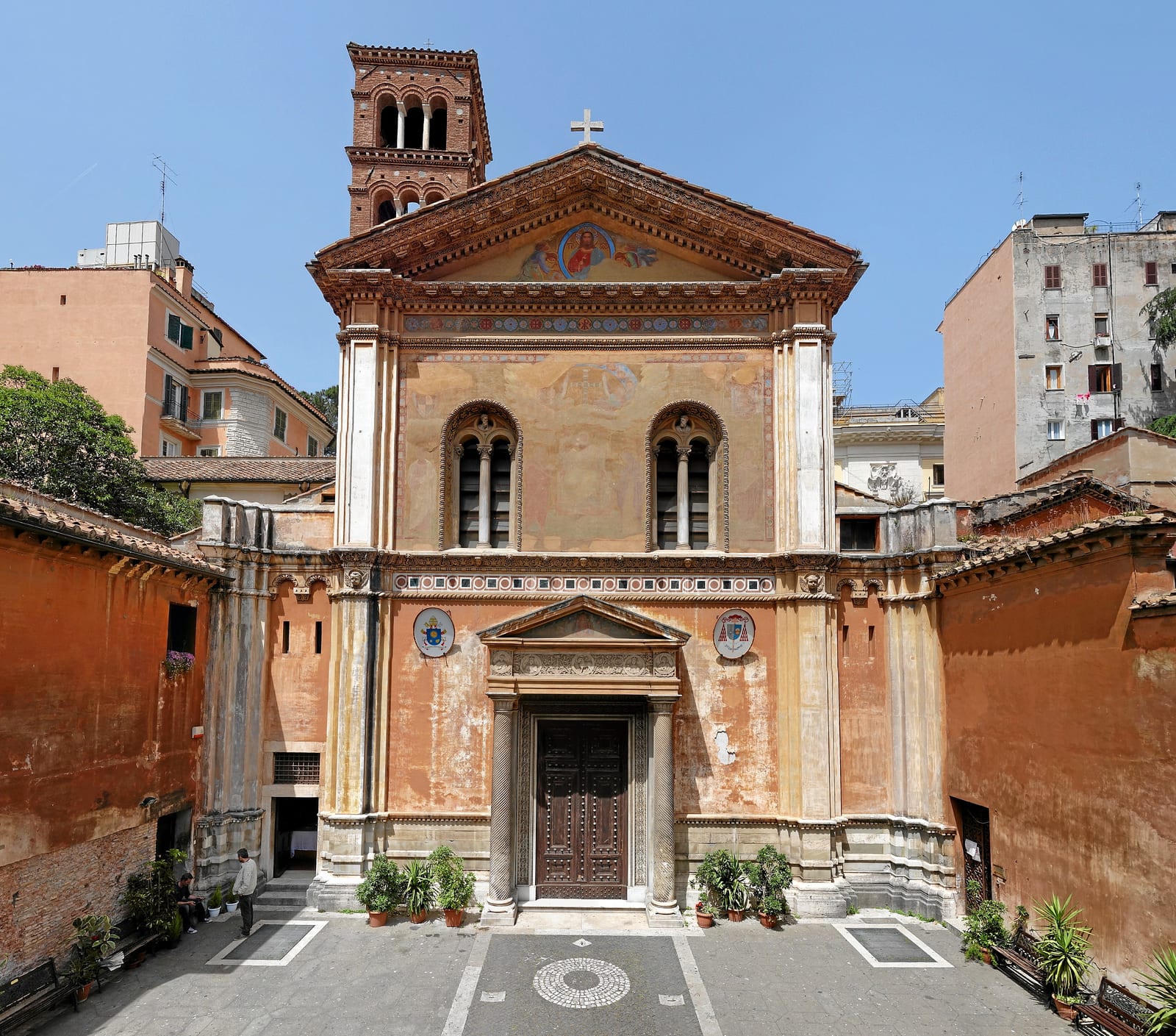
Santa Pudenziana on the Viminal hill is among the oldest churches of Rome. Tradition places it on the house of the senator Pudens, who is said to have given hospitality to St. Peter, and names it for his daughter Pudentiana, who with her sister Praxedes gathered the blood of the martyrs. Its fourth-century apse mosaic of Christ enthroned among the apostles is the earliest of its kind in the city. Off the left aisle stands the Caetani Chapel, begun in 1588 to designs of Francesco Capriani da Volterra and finished by Carlo Maderno after 1601, rich in coloured marbles and mosaic. It was here, in 1610, that the event the church still remembers took place.
A priest celebrating Mass at the chapel altar was seized, the tradition says, by doubt about the Real Presence of Christ in the sacrament. Immediately after the consecration the Host slipped from his hands and fell onto the marble step before the altar. Where it landed it left an imprint in the shape of the Host, together with a stain which the church has always described as blood. Both marks are still shown on the step of the Caetani Chapel, where the sacristan points them out to visitors; the Vatican International Exhibition panel reproduces close-up photographs of the round impression and the darker stain beside it.
The account rests on the church's own continuous memory and on the physical marks themselves rather than on any surviving process or decree, and the name of the priest has not come down. It belongs to the same family of 'doubting priest' miracles as Bolsena and Lanciano, and is generally read as a reminder that the sacrament does not depend on the faith of the minister. Santa Pudenziana remains a living parish; since 1991 it has also served as the national church of the Filipino community in Rome, and the Caetani Chapel with its marked step is open to pilgrims.