
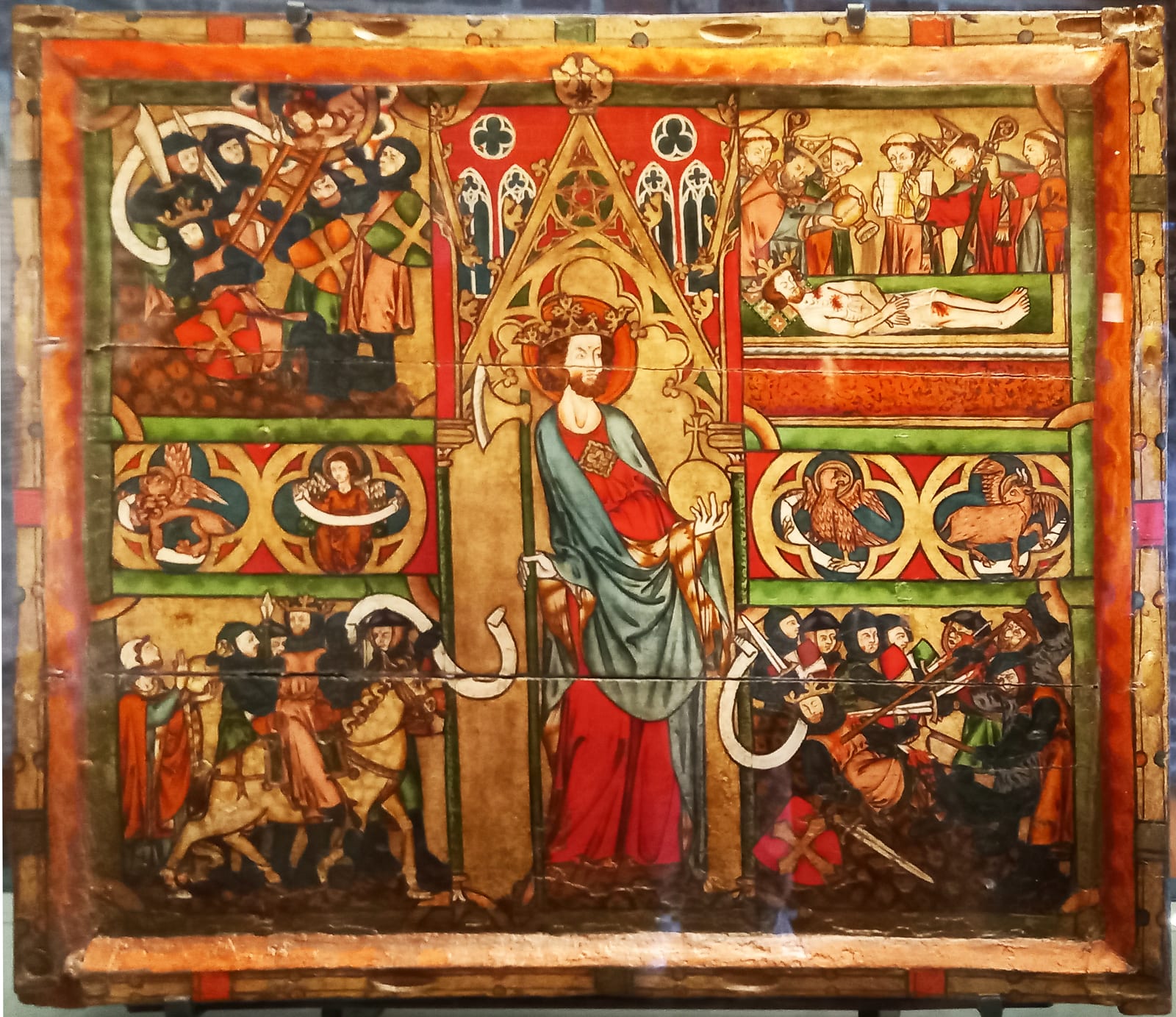
Olaf was killed at Stiklestad on 29 July 1030, fighting the chieftains and farmers who had turned against him. His body was brought to Nidaros (Trondheim) and buried in the sand on the bank of the river. Within months, says the Catholic Church in Norway, word ran through Trøndelag that he was holy.
On 3 August 1031 Bishop Grimkell had the coffin opened before witnesses. The body was found 'as fresh as when he lived', the hair and nails grown, and Grimkell, 'with the king's consent and the judgement of the whole people', declared him a saint and enshrined him by the high altar of St. Clement's church. That was how a saint was made before the popes reserved canonisation to themselves, and it is the only judgement the Church has given on these events. The earliest witness is the skaldic poem Glælognskviða, of about 1032, which already tells of the incorrupt body, of bells ringing of themselves above it, and of the blind healed; Snorri's saga of about 1230 adds the fragrance and the red cheeks. Where the coffin had lain in the sand a spring rose that was held to heal.
Nidaros Cathedral, begun about 1070 by his nephew, was built over the grave, and Olaf's shrine — at last a silver one over the older wooden coffin — made Trondheim the goal of one of the great pilgrimages of medieval Europe. In 1540, after the Reformation, the shrines were broken up and about 95 kilograms of their silver sent to Copenhagen; when the coffin was opened then the body is reported to have been still whole. Swedish soldiers carried it off in 1564; it was brought back and buried in the cathedral, and in 1568, by royal order, the grave was filled with earth and left unmarked so that pilgrims would stop coming. It has not been found.
The pilgrim roads to Nidaros were reopened in 1997, and every 29 July the feast of Olsok is kept at Stiklestad and in Trondheim, by Catholics and Lutherans both. The Catholic cathedral of Oslo, St. Olav's, keeps a relic given in 1862.