
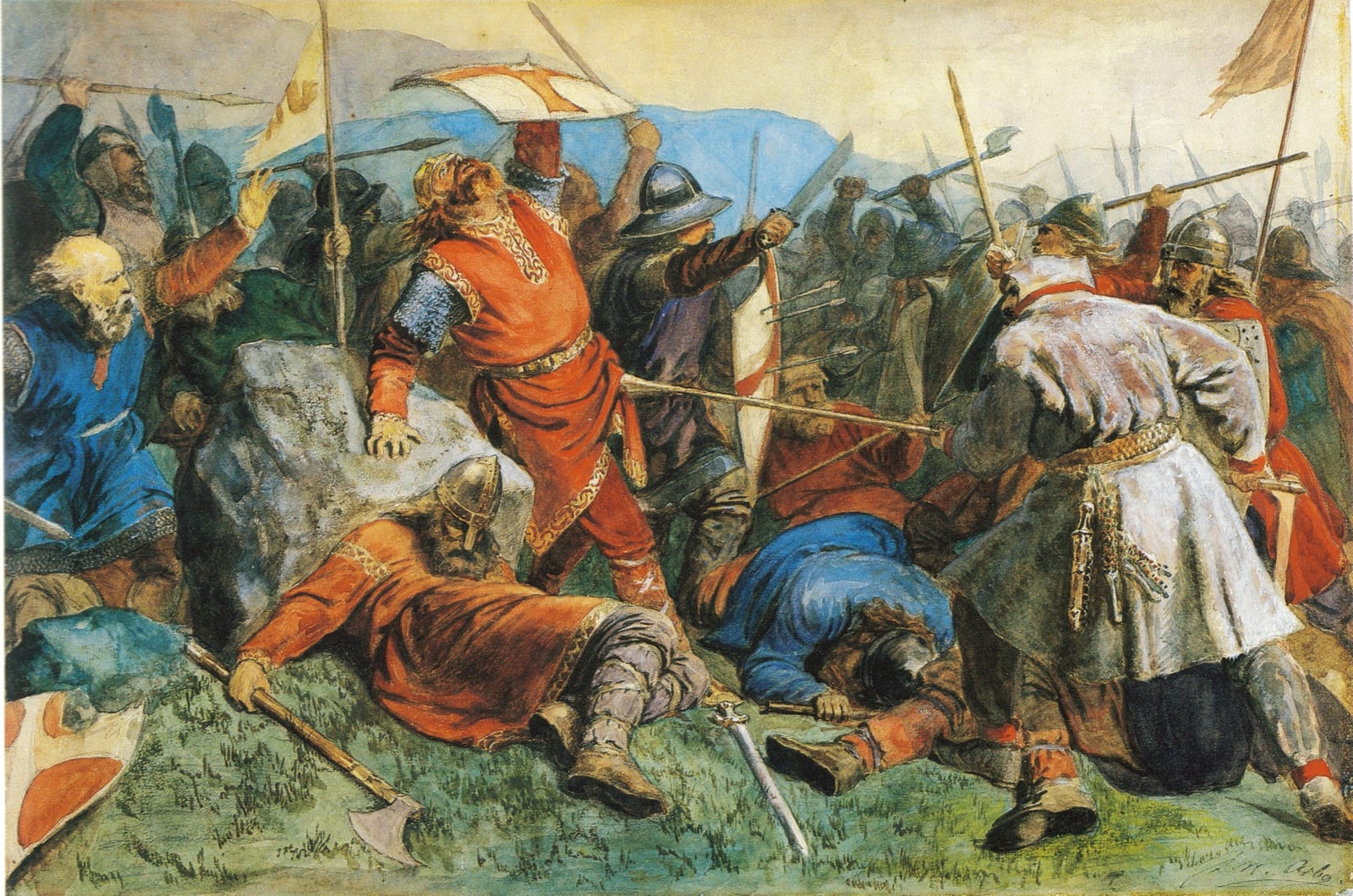
Saint — Olaf of Norway (Olav Haraldsson)

St. Olaf of Norway (Olav Haraldsson)
c. 995, Ringerike, Norway — July 29, 1030, Stiklestad
Rex Perpetuus Norvegiae — the eternal king of Norway
Stiklestad Church — built, by tradition, where he fell, Norway
Feast
July 29 (Olsok — a solemnity in Norway; not on the General Roman Calendar, where July 29 is Martha, Mary and Lazarus)
Canonized
Declared holy at Nidaros by Bishop Grimkell, 'with the king's consent and the judgement of the whole people', on 3 August 1031 — the way saints were made before Rome reserved it to itself. Named in the Roman Martyrology. The often-repeated confirmation by Pope Alexander III in 1164 has no document behind it that could be found.
✠ MartyrKilled in battle at Stiklestad against an army of Norwegian chieftains and farmers; the Roman Martyrology calls him martyr → The Martyrs
Life

Olaf Haraldsson was born about 995 and raised on Ringerike by his stepfather Sigurd Syr. Like other sons of Norwegian chieftains he went raiding young — in the Baltic, in England, in France — and fought for the English king Æthelred against the Danes. Wintering at Rouen in 1013–14 he was baptised (the sources differ on the exact year), and he came home in 1015 resolved to rule all of Norway and to make it Christian.

He won the kingdom at the battle of Nesjar in 1016. With an English cleric, Bishop Grimkell, he set about building a Church in Norway, and the assembly at Moster in 1024 is remembered as the moment Christian law was accepted — though historians think some of the law later credited to him is younger. His methods were not gentle. The Catholic Church in Norway says it plainly: he offered 'gold, land and good gifts' to those who came over to him and threatened 'loss of property and life' to those who refused baptism.

In 1028 the Danish king Cnut, with the support of Olaf's own chieftains, took Norway, and Olaf fled to Sweden and on to Kievan Rus', where his brother-in-law Yaroslav the Wise ruled. In 1030 he came back with a small army and met a much larger force of farmers and chieftains at Stiklestad, on 29 July 1030, where he was killed. Snorri's saga, two centuries later, has the sun darken during the battle; the only eclipse over Norway that year fell on 31 August, and the darkness is best taken as part of the legend, while the date of 29 July stands in the Church's memory.

Within the year his enemies were telling of miracles. On 3 August 1031 Bishop Grimkell had the grave opened before witnesses: the body was found fresh, the hair and nails grown, and the bishop declared him a saint. The earliest witness is a skaldic poem composed about 1032, Glælognskviða, which already speaks of the incorrupt body and of the blind healed. His cult ran across the northern world — to churches of St. Olave in London and York, to Novgorod, to the Varangian guard in Constantinople — and Norway came to call him its 'eternal king'.

Nidaros Cathedral in Trondheim rose over his grave, and the pilgrim roads to it were among the great ones of medieval Europe. The Reformation ended that: in 1540 his silver shrines were broken up and some 95 kilograms of silver sent to the Danish king in Copenhagen; the body, carried off by Swedish troops in 1564 and brought back, was buried in the cathedral and in 1568, by royal order, the grave was filled with earth and left unmarked to stop the pilgrimages. No one has found it since. The pilgrim roads were reopened in 1997, Olsok is kept every 29 July at Stiklestad and Trondheim, and the Catholic cathedral of Oslo is dedicated to him.

Miracles & Phenomena
  • The incorrupt body, 1031

    August 3, 1031

    Found fresh, with hair and nails grown, when the grave was opened a year and five days after his death; the miracle on which he was declared a saint. It has its own entry on the map, at Nidaros.

    → Full miracle page
  • The spring at his first grave

    Where his coffin had lain in the sand by the river Nid, a spring broke out that was held to heal, and was a pilgrims' goal through the Middle Ages. Its water is piped today to a fountain near the cathedral, though no one can say for certain that it is the same spring.

  • The blind man at Stiklestad

    Snorri's saga tells of a blind man who touched his eyes with water stained by the dead king's blood and saw. It is a late story — the saga is of about 1230 — though the earliest poem already speaks of the blind healed.

  • Over the Varangians in battle

    The twelfth-century Passio et miracula beati Olavi tells that he appeared to the Norse guard of the Byzantine emperor in a battle against the Pechenegs, and they won. Which battle is meant — 1091 or 1122 — is disputed.

Relics
  • Body
    The lost grave of St. Olaf
    Nidaros Cathedral, Trondheim — exact place unknown

    Reburied in the cathedral in 1564 and hidden by royal order in 1568; modern attempts to find the grave have not succeeded.

  • Bodily relic
    Relic in the Catholic cathedral of Oslo
    St. Olav's Cathedral, Oslo

    A bone in a medieval arm-shaped reliquary, given by Queen Josephine and carried into the church on 3 August 1862. A radiocarbon dating published in 2012 placed it in his lifetime — consistent with the tradition, though not proof that it is his.

Iconography
  • The king with the axe

    Crowned and robed, holding the axe of his death and often an orb, sometimes treading on a crowned dragon or a man; the altar frontal of about 1320 in the Nidaros Cathedral museum shows him enthroned, with scenes of his death and of the opening of his grave.

Patronages
Norway
Sources & Further Reading