
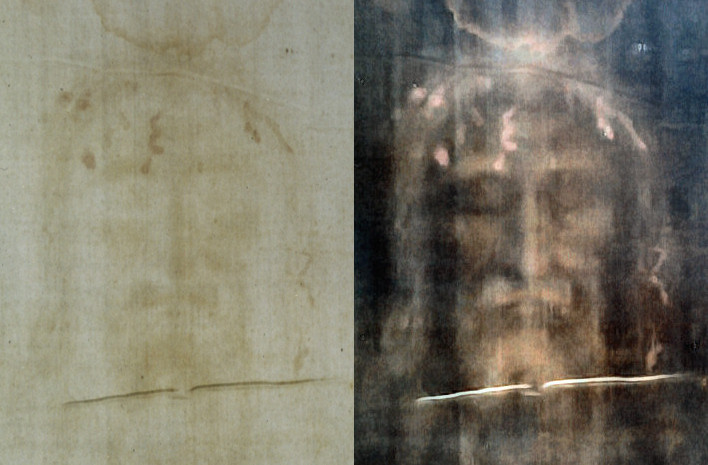
The Shroud is a length of linen 4.4 metres long and 1.1 metres wide, marked with the faint sepia-toned image of the front and back of a naked man bearing the wounds of crucifixion described in the Gospels — scourge marks, a wound in the right side, nail wounds in the wrists, head wounds consistent with a crown of thorns, and a swollen face. Stains of human blood (later confirmed as type AB) correspond exactly to the wound positions. The image, examined photographically by Secondo Pia in 1898, was found to be a negative — appearing as a positive on photographic plates.
It is documented at Lirey in France around 1354, taken to Chambéry in 1453 (where it survived a fire in 1532, leaving visible scorch marks), and brought to Turin in 1578. The 1978 STURP scientific study by 33 American scientists found no pigment, dye, or paint, and a superficial image only one fibre deep that defies known method of production. A 1988 carbon-14 dating placed the linen between 1260 and 1390 — but the sample was later shown to have been taken from a medieval reweave, and 2013 mechanical and chemical re-dating placed the linen consistent with a first-century origin. The Church has never pronounced formally on its authenticity; it calls it 'an icon of Christ's Passion' and continues to permit its veneration. Most recently exposed for public veneration in 2010 and 2015.