
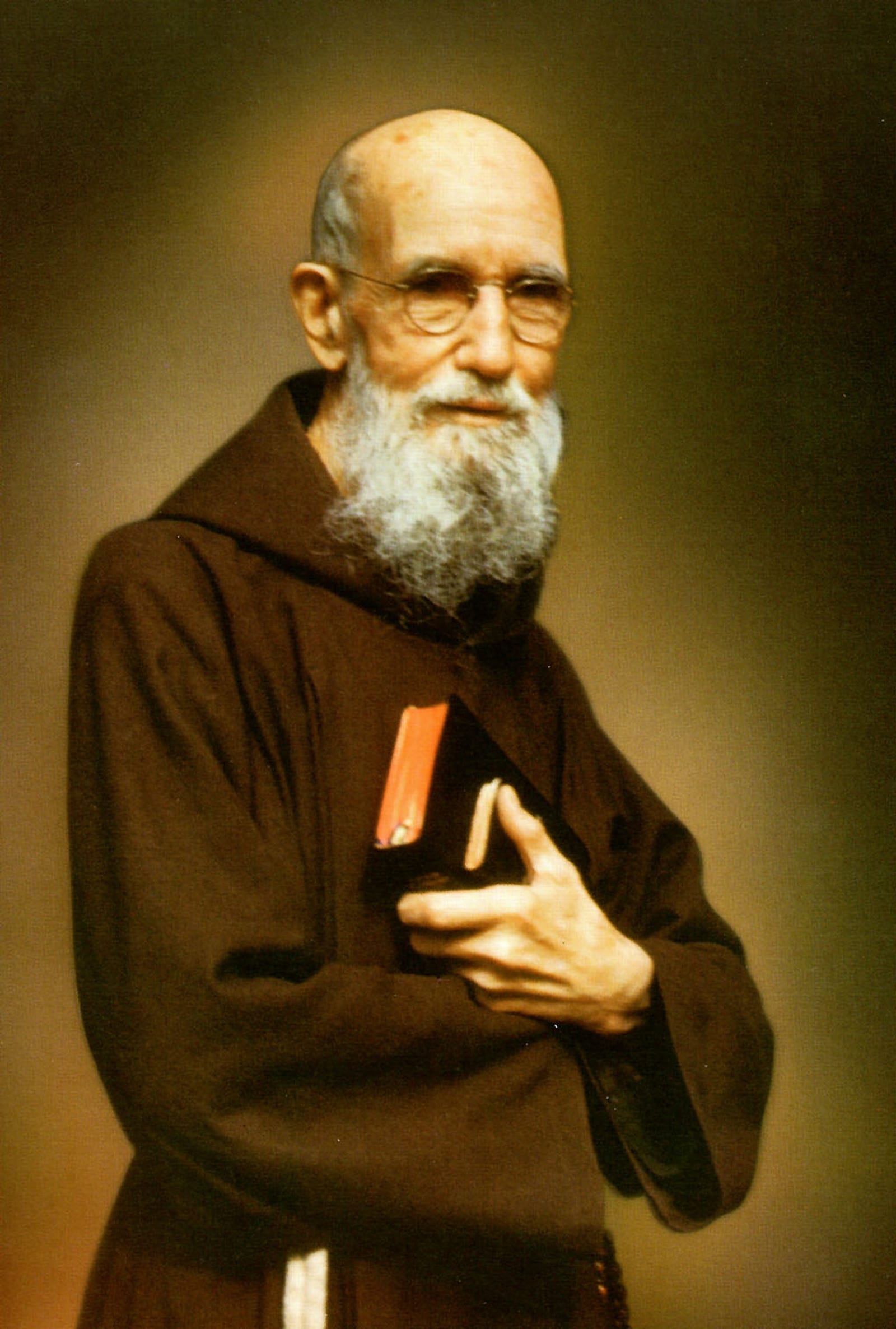
Bernard Francis Casey (1870–1957) was the sixth of sixteen children of an Irish-American family in Wisconsin. He worked as a lumberjack, hospital orderly, prison guard, and streetcar operator before entering the Capuchin Franciscans at twenty-six. He was ordained in 1904 as a 'sacerdos simplex' — a simple priest — meaning that because of difficulties with the Latin and German theology of his seminary, he was permitted to celebrate Mass but not to preach formal sermons or to hear confessions. He was assigned to be the porter — the doorkeeper — of his various Capuchin houses.
From 1924 to 1945, Fr. Solanus served as porter at St. Bonaventure Monastery in Detroit. His ministry was simple: he answered the door, received whoever came, listened, prayed, and blessed. He recorded the requests of those who came to him in a series of notebooks. Many came in physical distress — cancer, paralysis, infertility, mental illness — and many came back to thank him for cures they attributed to his prayers. He invariably deflected the gratitude: 'Thank God ahead of time. He never refuses anyone what He has prepared for them in His goodness.'
By the time of his death in 1957, the volume of cures and graces reported to him had exceeded any record-keeping. His notebooks, preserved at the Solanus Casey Center in Detroit, document over six thousand specific cases of healing — physical and spiritual — that came back to him with thanks. The Capuchin postulator's investigation, conducted from 1976 onward, added thousands more.
Solanus Casey was declared Venerable by Pope John Paul II in 1995. The miracle of Paula Medina-Zarate of Panama — healed of an incurable skin disease in 2012 after praying at Solanus's grave — was accepted by the Holy See, and Solanus was beatified in Detroit on November 18, 2017, in a Mass attended by over 60,000 people in Ford Field. His tomb at the Solanus Casey Center continues to draw pilgrims from across North America. He is the second American-born man to be beatified.