
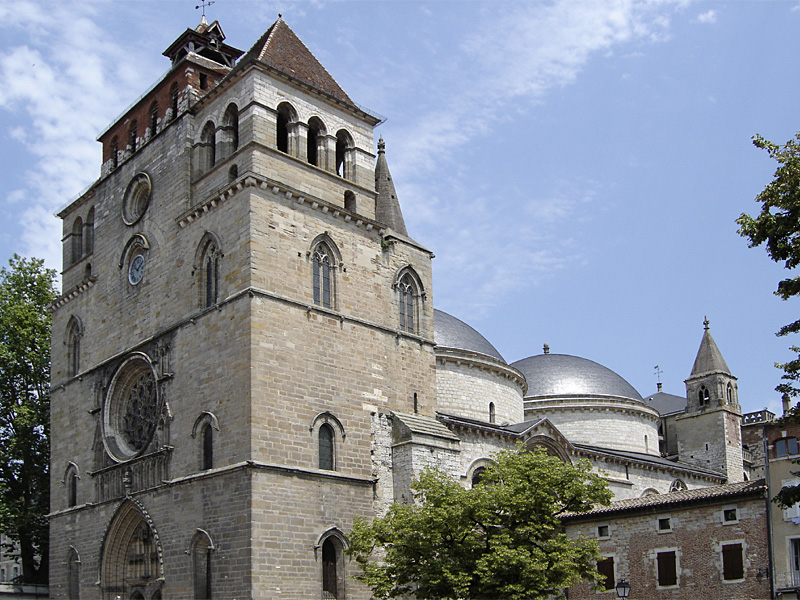
The Holy Coif of Cahors (Sainte Coiffe) is a small piece of linen, roughly the size and shape of a close-fitting head covering, with traces of dried bodily fluid stains. It has been preserved at the Cathedral of Saint-Étienne in Cahors in the south-west of France since at least 1113, when Bishop Géraud de Cardaillac is recorded as bringing it from the Holy Land after the First Crusade.
The Coif's pious identification is as one of the burial linens of Christ — possibly the same soudárion mentioned in John 20:7 alongside the empty tomb linens, distinct from the Sudarium of Oviedo (which is identified with the face-cloth carried before the burial and removed at the tomb). Recent comparative studies have suggested the Coif's blood-stain pattern is consistent with corresponding regions of the Shroud of Turin head image, though the comparison is less precise than the Oviedo–Turin correspondence. The relic is preserved in a precious reliquary in the cathedral.