
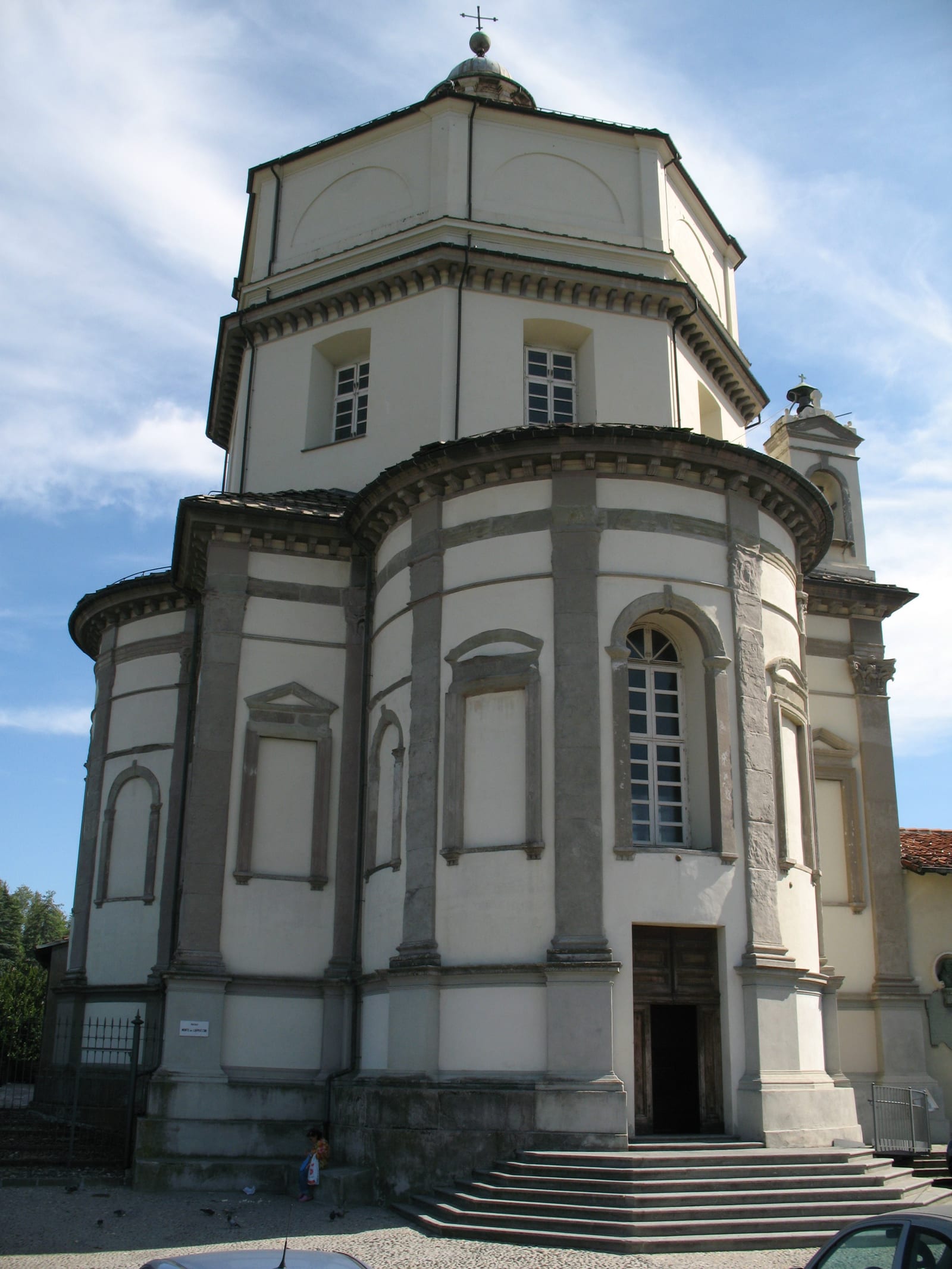
Turin's second Eucharistic miracle (the first, in 1453, gave the city its Corpus Domini basilica) took place during the French campaign in Piedmont in 1640. After Casale Monferrato was taken from the Spaniards, the army of Henri de Lorraine, Count of Harcourt, advanced on Turin, reaching Chieri on 6 May, Moncalieri on the 7th and the capital on the 10th. Having seized the left bank of the Po and its bridge, the French moved against the Capuchin friary on the Monte, the hill above the river whose church of Santa Maria, begun in 1583 to designs by Giacomo Soldati and Ascanio Vitozzi, was still awaiting consecration. The defenders dug in, and on the morning of 12 May the attackers twice stormed the trenches and were twice repulsed.
On the third assault the Piedmontese troops broke and fled with the civilians into the church, seeking sanctuary. The invaders followed them in. The Capuchin chronicler Friar Pier Maria da Cambiano, whose detailed narrative is the source of the exhibition panel, records that men and women, young and old, soldiers and civilians were cut down even as they clung to the altars or to the friars; the friars themselves were spared. The soldiers then looted the friary, where refugees had stored their goods, and profaned the church. Finally one French soldier, described as an unbeliever, climbed onto the altar and forced open the tabernacle to seize the ciborium and the consecrated Hosts it contained.
At that moment, the chronicle says, a flame blazed out of the ciborium and struck the soldier, scorching his uniform and his face. He fell to the floor screaming and begging God's forgiveness, the church filled with dense smoke, and amid the terror and astonishment the violence stopped. The tabernacle of the miracle, inlaid with agate and lapis lazuli, is still shown in the church; tradition holds that it carries the print of the soldier's burnt hand, and bayonet marks and traces of fire remain visible on it. An old painting in the church's atrium commemorates the event. The church was finally consecrated on 22 October 1656. The account rests on the Capuchin chronicle rather than on any formal ecclesiastical process, and is presented here as such.
The Monte dei Cappuccini remains one of Turin's most loved vantage points, and the church is visited today both for its Baroque interior and for the tabernacle of 1640. In the exhibition the miracle stands alongside the better-known 1453 event: two moments, two centuries apart, in which the same city's devotion to the Blessed Sacrament was tested by war.