
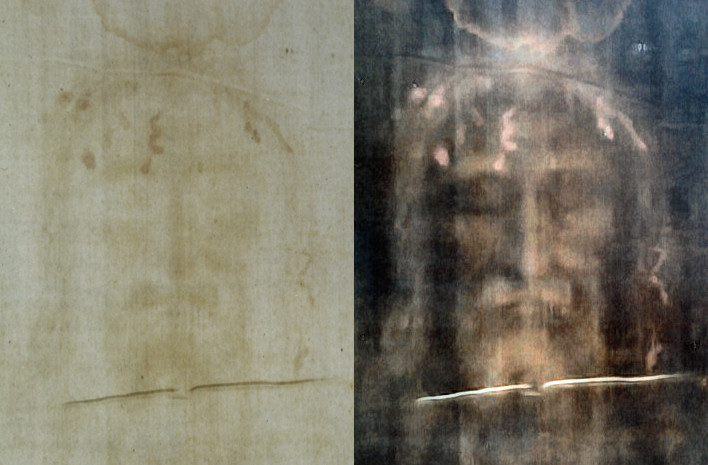
On the night of December 3–4, 1532, a fire caught in the Sainte-Chapelle of the Ducal Palace at Chambéry, where the Shroud had been enshrined by the House of Savoy since 1471. The relic was locked in a silver casket set within an iron grille above the altar; four men — two Franciscans, a locksmith, and the sacristan — pried the grille open with a sledgehammer and dragged the casket out. Molten silver from the reliquary had already dripped through onto the folded cloth.
When the cloth was unfolded, the drops had burned symmetric holes through each of its forty-eight folds — the diamond-shaped scorches still visible on the Shroud today, most obvious on the arms and torso. The image itself — the frontal and dorsal impression of a scourged and crucified man — was untouched.
The Poor Clare sisters of Chambéry repaired the burns with sixteen triangular patches in 1534; those patches remained until the modern restoration of 2002, which removed them and the Holland cloth backing sewn on at the same time. The cloth was translated to Turin in 1578; it remains at the Cathedral of Turin, and is now displayed only on rare occasions.