
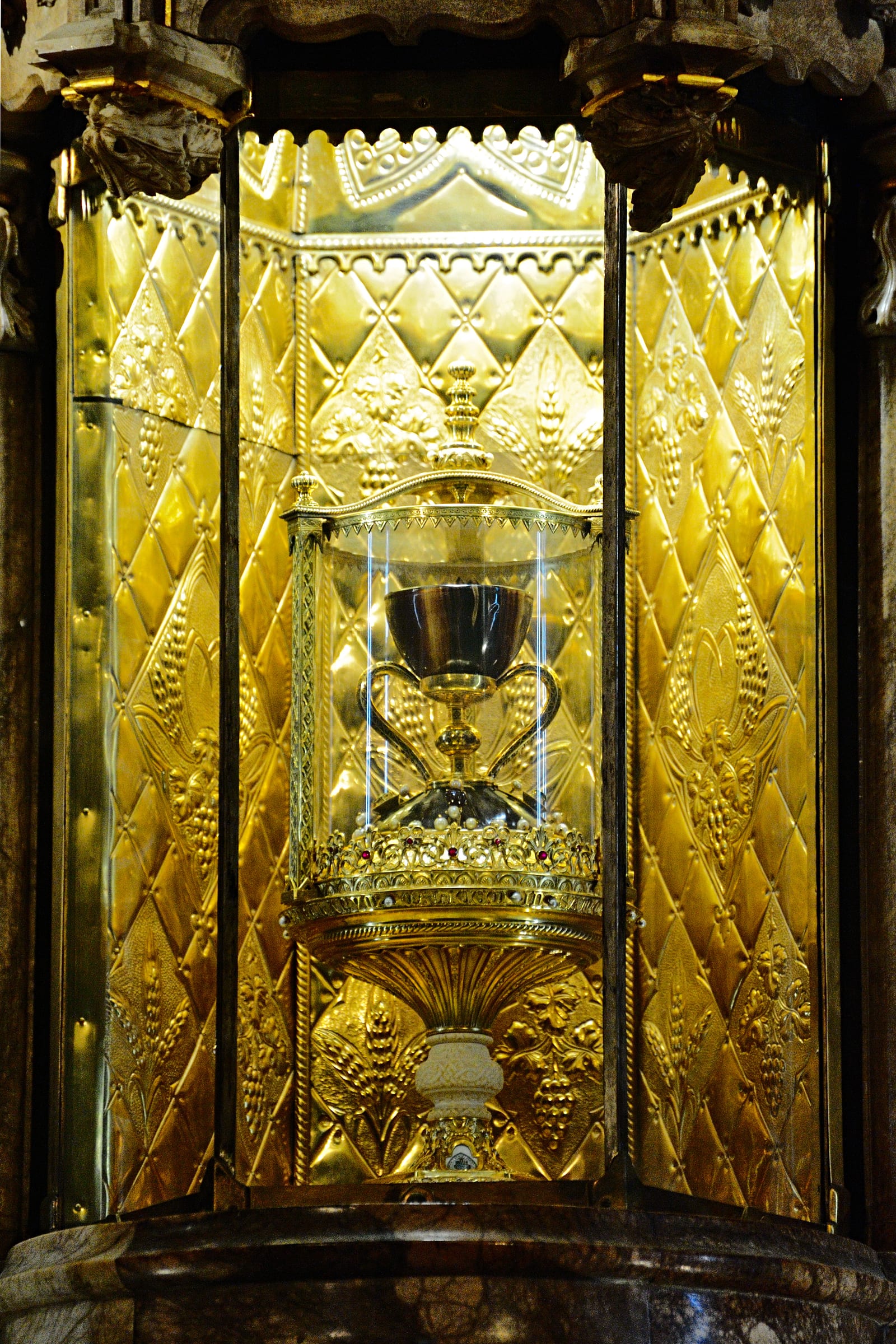
The Vatican exhibition's panel for Valencia covers no bleeding Host or apparition; it is devoted to the Holy Chalice, the cup which tradition holds that Jesus used at the Last Supper to consecrate the wine, and which legend also identifies with the vessel in which Joseph of Arimathea gathered his Blood. The panel first sets the relic against the Grail romances of Perceval and Parzival, Wagner and the modern novels, and then insists, quoting Salvador Antuñano, that there is nothing esoteric in it: its history concerns 'the Word made man and the Eucharist'. It recalls that the pilgrim bishop Arculf, around 680, saw a chalice venerated in the Holy Sepulchre as the Lord's, and that Bede adds it was kept under a net and kissed through an opening; no one knows when that cup left Jerusalem.
The object itself is composite. The upper part is a polished cup of dark red agate about 9 cm across; Antonio Beltrán's 1960 study dated it to between the second century BC and the first century AD and assigned it to a Levantine or Egyptian workshop. The knobbed gold stem set with pearls and gems, the two handles and the inverted chalcedony foot are medieval additions; the foot carries a Kufic inscription whose reading is disputed. Spanish tradition says St Peter brought the cup to Rome, that the deacon Lawrence sent it to his native Huesca before his martyrdom in 258, that it was hidden in the Pyrenees and kept at San Juan de la Peña, where a 1134 inventory describes it as the chalice in which Christ consecrated His Blood. King Martin I took it into the royal chapel in 1399, and in 1437 it was deposited in Valencia Cathedral, the document of that reception being one of the panel's illustrations.
The chalice broke on Good Friday 1744 and was repaired; it was hidden during the Civil War and is now shown in the fourteenth-century former chapter house (1356–69), rebuilt as the Chapel of the Holy Chalice, together with a note by St Juan de Ribera certifying that it 'is preserved in our cathedral'. John Paul II celebrated Mass with it on 8 November 1982 and Benedict XVI at the World Meeting of Families on 9 July 2006, and the Holy See has granted Valencia a recurring Jubilee Year of the Holy Chalice. The Church has never defined the relic's authenticity, and scholars can only say the cup is ancient enough to have stood on a first-century table; the site presents it as a venerable tradition whose weight lies in what it points to, the institution of the Eucharist.