
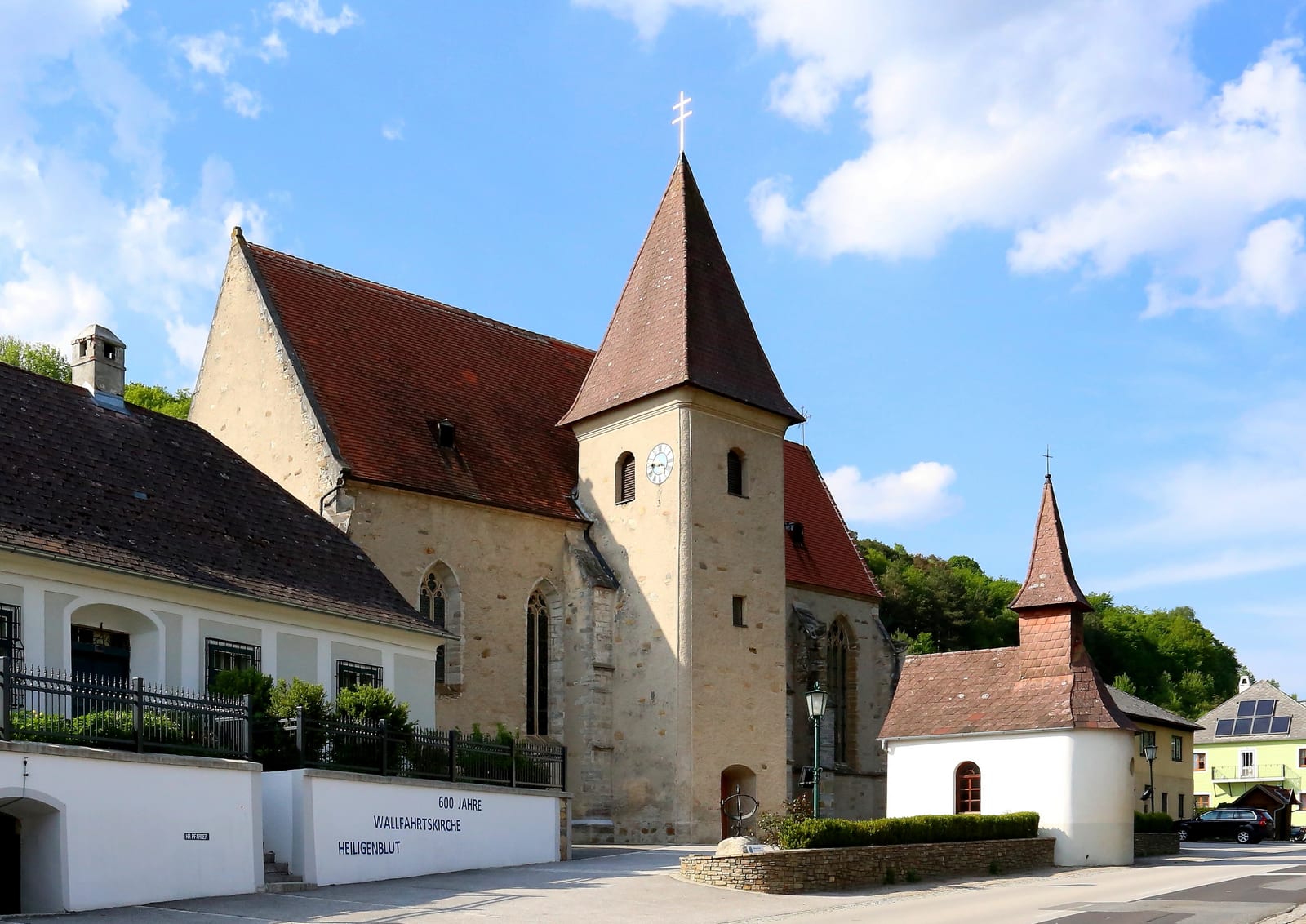
In 1411 a thief broke into the sacristy of the parish church of Weiten, in the hills of Lower Austria between the Danube and the Waldviertel, and carried off a consecrated host hidden in his glove. He rode toward Spitz by the side road through the Mühldorf valley. At a spot now marked by a chapel, his horse refused to go on and then suddenly bolted, and the host slipped from the glove and fell unnoticed to the ground.
Some days later a woman of Mannersdorf, remembered by the name Scheck, found the host lying in the field surrounded by a brilliant light. It had broken into two pieces, yet the halves were joined by threads of bleeding flesh. At her own expense she raised a small chapel of thanksgiving over the place — the Ursprungskapelle, the 'chapel of origin', which still stands. Pilgrims came at once, and beside the little chapel a pilgrimage church was built: the choir in the second quarter of the fifteenth century, the nave between 1480 and 1494. A stained-glass window of the mid-1400s in the church depicts the miracle, and the whole complex, Heiligenblut — 'Holy Blood' — was restored between 2008 and 2011.
The miracle is carried in the Vatican International Exhibition under the name Weiten-Raxendorf: Weiten for the church the host was taken from, Raxendorf for the parish in which it was found. It belongs to the great family of medieval Austrian and German Holy-Blood pilgrimages, and unlike several of them, its shrine, its chapel of origin, and its fifteenth-century window all survive.