
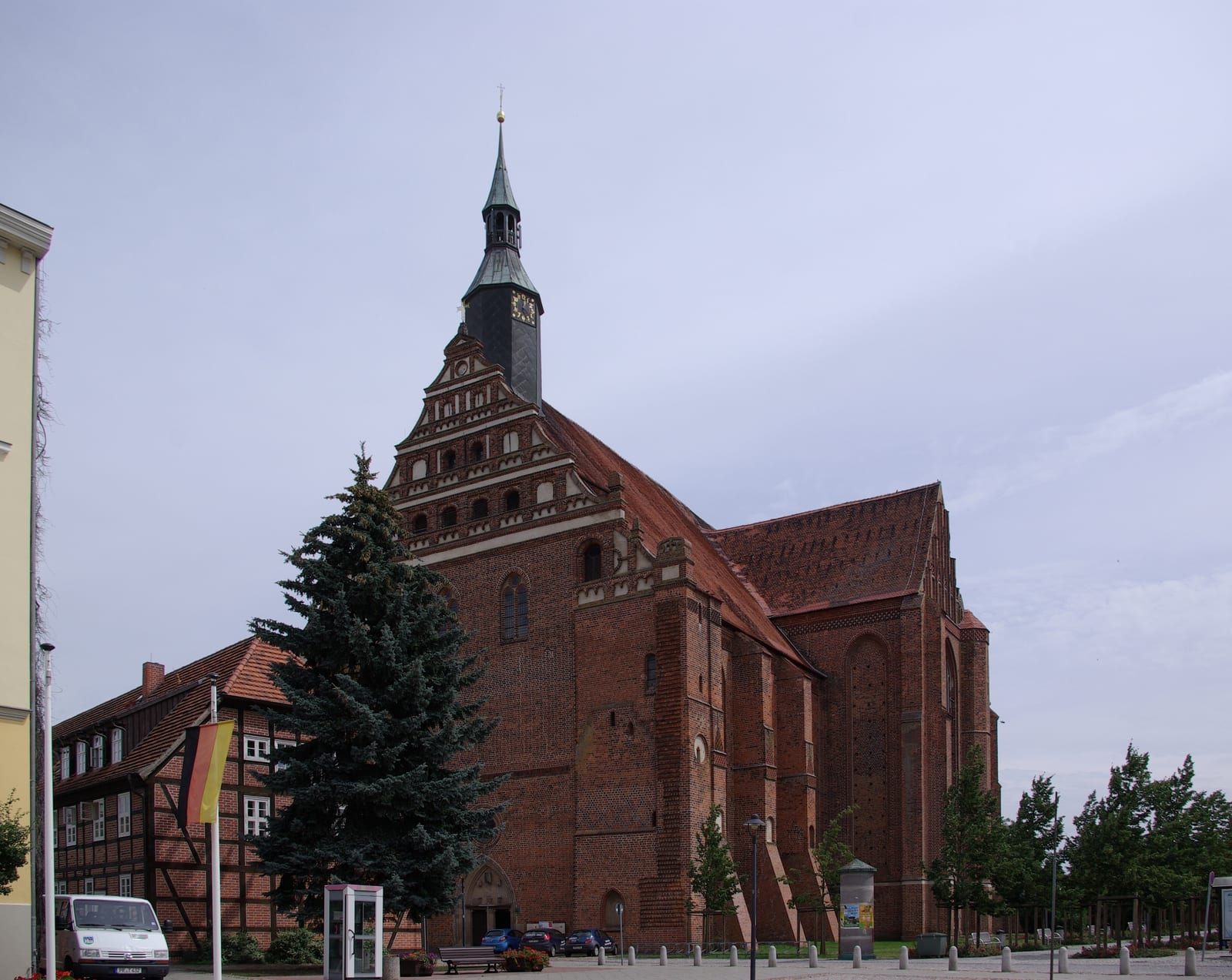
On 15–16 August 1383, while the people were away at a church festival in Havelberg, the knight Heinrich von Bülow, feuding with the bishop, sacked and burned the village of Wilsnack in the Prignitz. Searching the ruins of the parish church, the priest Johannes Kabuz (Cabbuez) found on the altar three consecrated hosts, unburned, each bearing what looked like a drop of blood. Bishop Dietrich Man of Havelberg came to examine them — later accounts say the middle host welled with fresh blood before him — and confirmed the miracle in 1384. On 20 February 1384 Pope Urban VI granted an indulgence for the rebuilding of the church, and the Archbishop of Magdeburg and the bishops of Brandenburg, Havelberg and Lebus added their own.
Cures were reported at once; the exhibition panel recalls the knight Dietrich von Wenckstern, who doubted, lost his sight, and regained it on repenting. Pilgrims came from Bohemia, Poland, Hungary, Denmark and the Hanseatic towns; in 1411 Queen Margaret I of Denmark sent pilgrims to Wilsnack on the same footing as Santiago and Cologne. Their offerings and the sale of pewter badges of the three hosts paid for the vast brick-Gothic church of St. Nicholas, the Wunderblutkirche, finished around 1400 and still standing with its fifteenth-century shrine of the Holy Blood. Pope Eugene IV confirmed the devotion in two bulls of 1447.
Yet the Holy Blood was contested almost from the start, and honesty requires saying so. In 1405 the Archbishop of Prague, Zbyněk Zajíc, had the reported cures investigated; the young Jan Hus found no lasting healing among them, wrote against the cult, and the archbishop forbade the pilgrimage from Bohemia. In 1443 the Magdeburg canon Heinrich Tocke opened the monstrance and found nothing but "a mixture of crumbs and cobwebs," and spent a decade gathering evidence against the shrine. At the provincial council of Magdeburg in June 1451 the papal legate Nicholas of Cusa heard Tocke and issued a decree forbidding the veneration of bleeding hosts altogether — but in 1453 Elector Frederick II of Brandenburg went to Rome and obtained from Nicholas V a ruling that silenced the critics and let the pilgrimage continue. The question the medieval Church never resolved was settled by fire: in May 1552 Joachim Ellefeld, Wilsnack's first Lutheran pastor, opened the shrine and burned what remained of the hosts; he was imprisoned at the Plattenburg at the cathedral chapter's demand, then released and exiled by Elector Joachim II. The pilgrimage ended; the church, its shrine, and a remarkable woodcut broadsheet of the legend survive.