
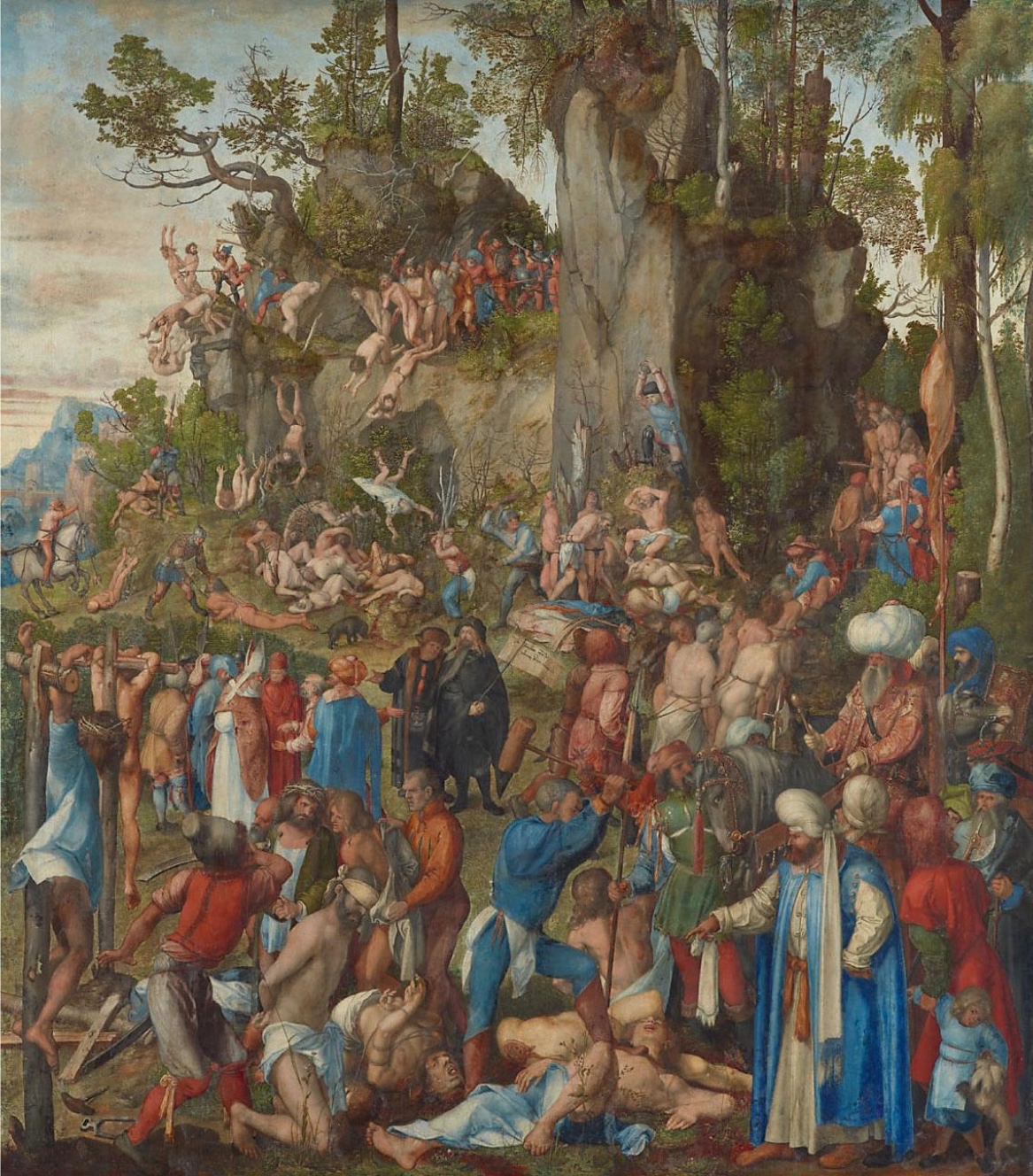
Honesty requires the warning first. Acacius is the weakest link in the chain of the Fourteen: the passion that carries his name — a Roman captain converted on the battlefield with ten thousand soldiers, all of them crucified together on Mount Ararat — appears only in the late Middle Ages, has no early witness whatever, and is rejected by every serious hagiographer. The Bollandists treated it as fiction. He was among the saints dropped from the general calendar in 1969.
He is kept on this site because the Fourteen Holy Helpers are prayed to together, and a group of fourteen with one silently removed tells the reader less than a group of fourteen with the truth attached. He is also a useful lesson in how a cult can grow: the ten thousand martyrs of Mount Ararat were painted by Carpaccio and by Durer, endowed with altars across Bavaria and the Rhineland, and invoked for centuries by people whose faith was real even though the story was not.
What the devotion actually asks of him is help in headache and in the agony of death. That petition is answered by God, not by the accuracy of a fifteenth-century passion; but a reader has a right to know which is which.