
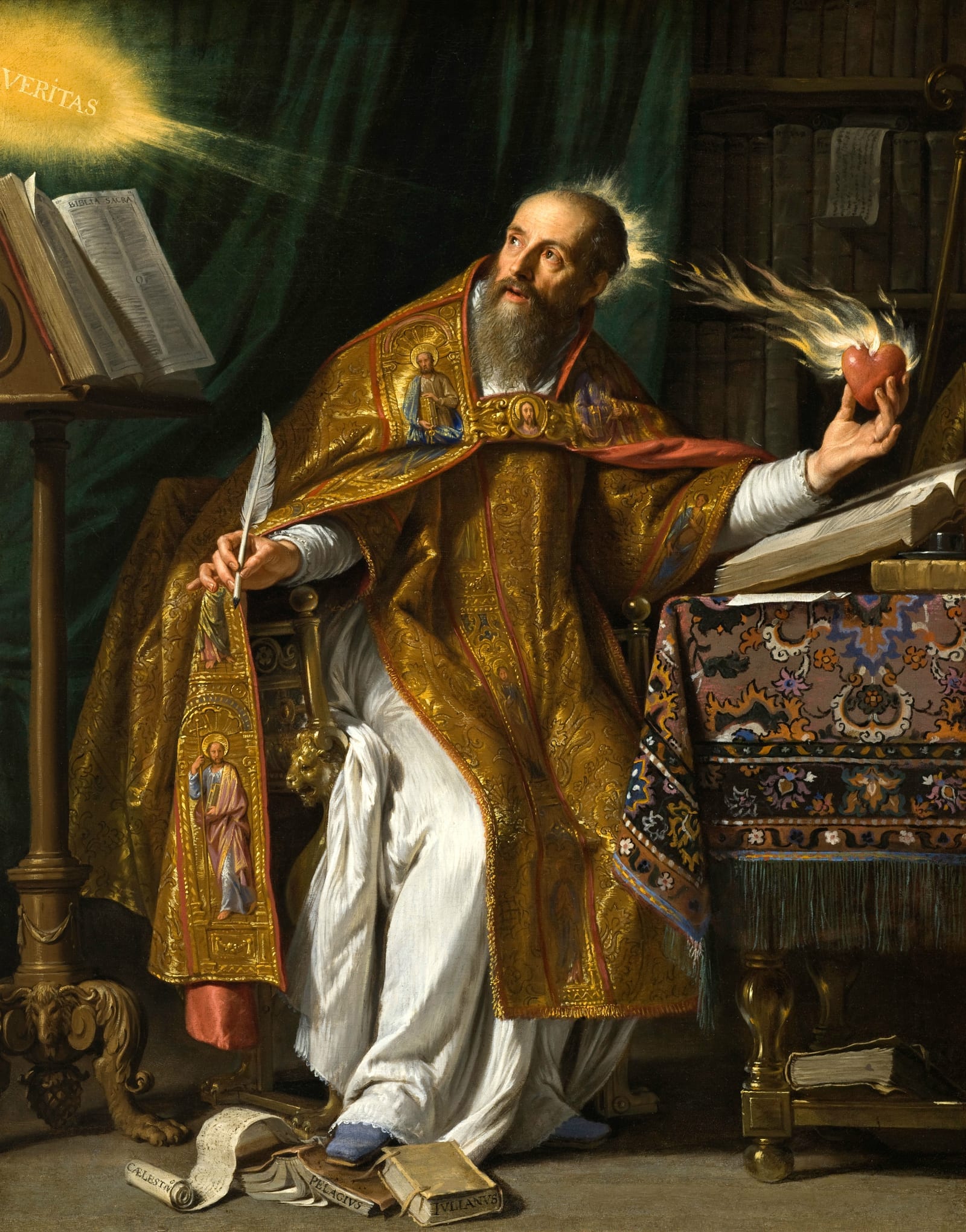
Aurelius Augustinus was born at Thagaste in Roman North Africa to a pagan father, Patricius, and a Christian mother, Monica — who would, after seventeen years of prayer, see him baptised. Brilliant from boyhood, he was sent to Carthage to study rhetoric, where he abandoned his mother's faith, took a concubine, and fathered a son, Adeodatus. For nine years he was a Manichaean.
He moved to Rome and then to Milan to teach rhetoric. There, under the preaching of Ambrose and the prayers of Monica, he experienced his famous conversion in a garden in 386: hearing a child's voice chant 'tolle lege' (take and read), he opened the Letters of Paul at Romans 13:13–14 and read the words that ended his old life. Baptised by Ambrose at the Easter Vigil of 387, he returned to Africa, was ordained priest at Hippo Regius, and in 395 became its bishop.
For the next thirty-five years he produced, against constant pastoral pressure, the most influential body of theology in Western Christianity. The Confessions (c. 397–400) — the first true autobiography in Western literature, the great prayer of a soul to God. The City of God (413–426) — the response to those who blamed Christianity for the sack of Rome in 410, the first Christian philosophy of history. On the Trinity, On Christian Doctrine, the Enchiridion, the great anti-Pelagian works on grace.
He died at Hippo on August 28, 430, while the Vandals were besieging the city — the last city of Roman North Africa to fall. His relics were rescued from the Vandals and eventually translated to Pavia, where they remain in the gold-ceilinged basilica of San Pietro in Ciel d'Oro. He is the most quoted author in every subsequent papal encyclical and in the documents of the Second Vatican Council.