
MIRACULOUS MIRACLES™

Saint — Benedict of Nursia

St. Benedict of Nursia
c. 480, Nursia (modern Norcia, Umbria) — March 21, 547, Monte Cassino
Father of Western Monasticism — Patron of Europe
Monte Cassino Abbey, Italy
Feast
July 11 (Roman); March 21 (older calendar)
Life

Benedict was born to a noble Umbrian family and sent to Rome for the rhetorical education appropriate to his class. Repelled by the licentiousness of the city, he abandoned his studies at twenty and withdrew to a cave at Subiaco in the Sabine hills, where he lived as a hermit for three years, fed by the monk Romanus who lowered bread to him on a rope.

Disciples gathered around him; he organized twelve small monasteries of twelve monks each at Subiaco, then moved with a few companions south to Monte Cassino around 529. There, on the site of a Roman temple of Apollo which he destroyed, he founded the great abbey that bears his name and composed his Rule — seventy-three short chapters of practical spiritual wisdom for cenobitic life.

The Rule of Benedict — moderate, humane, balancing prayer (ora) and work (labora), demanding obedience and stability but never extreme asceticism — became the foundational document of Western monasticism. For some six centuries it was the only Rule followed in Latin Europe. From Monte Cassino sprang all the great Benedictine houses — Cluny, Monte Cassino itself, Saint-Denis, Westminster, St. Gall, Subiaco, Camaldoli, Vallombrosa, the English Benedictines — and from them all the subsequent religious orders of Latin Christianity took their pattern.

He died on March 21, 547, standing in prayer at the altar of Monte Cassino, supported by his brethren, after receiving the Eucharist. Pope St. Gregory the Great preserved his life and miracles in the second book of his Dialogues (593–594) — our principal source for his biography. Paul VI declared him Patron of Europe in 1964.

Miracles & Phenomena
  • The Broken Sieve Mended

    As a young man, Benedict's nurse broke an earthen sieve; he prayed and the pieces were rejoined whole — his first miracle, recorded by Gregory.

  • Water from the Rock

    When his monks complained of having to descend a cliff for water, Benedict prayed; water sprang from the rock on the mountainside near their monastery.

  • The Poisoned Cup Shattered

    The monks of Vicovaro, whom Benedict had agreed to lead, tried to poison him at table. He blessed the cup with the sign of the cross; it shattered.

  • Vision of the World in a Beam of Light

    On the night of his death, Benedict saw the whole world gathered up as if in a single beam of sunlight — the great mystical vision of Gregory's Dialogues Book II.

Relics
  • Body
    Tomb of Benedict and Scholastica
    Monte Cassino Abbey (and Saint-Benoît-sur-Loire, France)

    His tomb is at Monte Cassino with that of his sister Scholastica; some relics translated to Fleury (Saint-Benoît-sur-Loire) in the 7th century.

Iconography
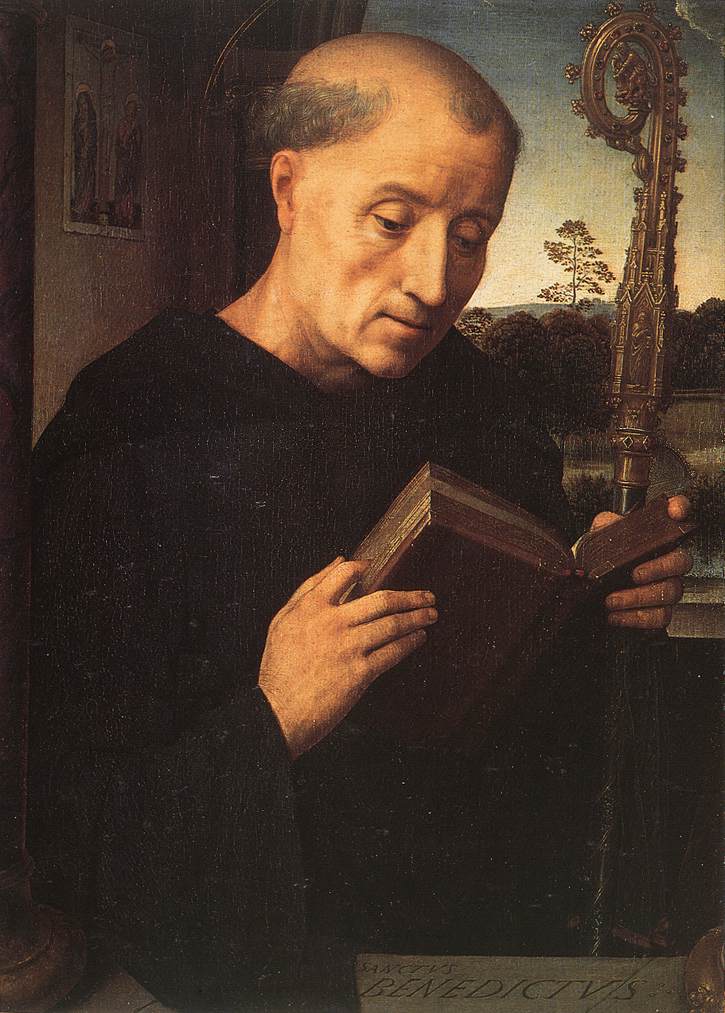
  • Benedict with Rule and Raven

    The black-robed abbot holding the open Rule, with a raven (which once carried away a poisoned loaf at his command) at his side, and a shattered cup at his feet.

Prayers Composed by This Saint
  • Digneris mihi donare, Pater pie et sancte

    'Grant me eyes to see Thee, a tongue to proclaim Thee, patience to wait for Thee, perseverance to look for Thee' — the short prayer preserved under Benedict's name in the works of Alcuin.

    Read the full prayer →
Prayers to This Saint
Patronages
Europe (Pope Paul VI, 1964)Monastic lifeSpeleologists (he lived in a cave at Subiaco)Against poisonSchoolchildren and students
Sources & Further Reading