
MIRACULOUS MIRACLES™

Saint — Bonaventure

St. Bonaventure
AD 1221, Civita di Bagnoregio — July 15, 1274, Lyon
Doctor Seraphicus — the Seraphic Doctor
Parish church of San Nicola, Bagnoregio, Italy
Feast
July 15
Canonized
Canonized 1482 (by Sixtus IV); Doctor 1588 (by Sixtus V)
Doctor of the Church
Yes
Life

Giovanni di Fidanza was born at Bagnoregio in central Italy. As a small child he is said to have been gravely ill and to have been cured by the prayers of St. Francis of Assisi, who exclaimed: 'O buona ventura!' ('O good fortune!') — and the boy took the name as his own.

He joined the new Franciscan order around 1238, studied at Paris under Alexander of Hales, and there became a teaching colleague and intimate friend of his great Dominican counterpart Thomas Aquinas. Elected Minister General of the whole Franciscan Order in 1257 — at just thirty-six — he served in that office for seventeen years through one of the most turbulent periods in the order's history, holding the conventual and spiritual wings together by a combination of personal sanctity, doctrinal clarity, and immense administrative patience.

His writings — the Itinerarium Mentis in Deum ('The Mind's Journey into God'), the Breviloquium, the great commentary on Peter Lombard's Sentences, the Life of St. Francis (the official biography that all earlier Lives were ordered to be destroyed in favour of) — are the central monument of Franciscan theology and of medieval Christian mysticism. He was made Cardinal-Bishop of Albano by Pope Gregory X in 1273; tradition holds that the papal legates found him washing the dishes when they arrived and that he asked them to hang his cardinal's hat on a tree until he was finished.

He died at the Second Council of Lyon in 1274 — having delivered a crucial sermon that secured a brief reunion of the Greek and Latin churches. Aquinas had died on the way to the same council four months earlier.

Miracles & Phenomena
  • The Itinerarium Mentis in Deum (1259)

    Composed at La Verna — the mountain where Francis received the stigmata — this brief masterpiece traces the soul's ascent to God through seven stages, from creation to the dark cloud of mystical union. It is the densest single work of medieval mystical theology.

  • Reunion of the Greek Church at the Second Council of Lyon (1274)

    May–July 1274

    Bonaventure's preaching, theological work, and personal diplomacy at the Council secured a formal reunion of the Greek and Latin Churches — proclaimed at the Council, though it would not survive the political crises of the next decade.

Relics
  • Bodily relic
    Arm of St. Bonaventure
    Parish church of San Nicola, Bagnoregio

    His body, found incorrupt at the 1434 translation, was burned in the public square of Lyon by Huguenots in 1562; the head reliquary was hidden in the church and lost when the church was razed during the French Revolution. The only major extant relic is his right arm — with which he wrote his Commentary on the Sentences — preserved in the parish church of his birthplace.

Iconography
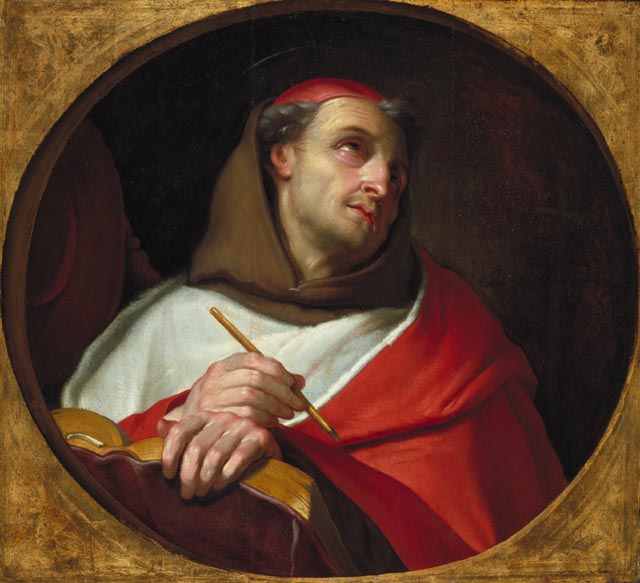
  • Bonaventure with the Eucharist in His Hand

    A traditional iconographic type — Bonaventure holding the Sacred Host as he received Communion on his deathbed, the angel having brought him the Viaticum because he was too humble to ask his confreres for it.

  • Apotheosis of St. Bonaventure
    Francisco de Zurbarán; Murillo; many others

    Painted by Francisco de Zurbarán in a great cycle for the Franciscan college of Seville (c. 1629), and by many others. Bonaventure is recognisable by the cardinal's red hat hung on a tree behind him or carried by an angel.

Prayers Composed by This Saint
Patronages
Workers in silkBowel disordersBagnoregioTheologians
Sources & Further Reading