
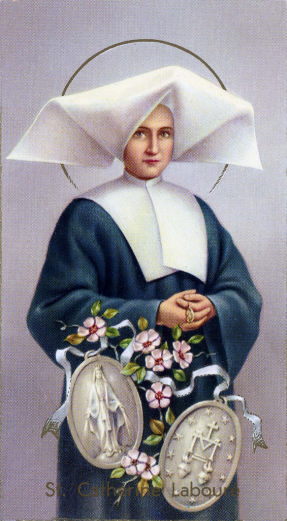
Catherine Labouré was the ninth of seventeen children of a Burgundian farming family at Fain-lès-Moutiers. Her mother died when she was nine; she effectively ran her father's household until she was twenty-four. She entered the Daughters of Charity (founded by Vincent de Paul and Louise de Marillac, see those entries) at the small Paris mother-house on the Rue du Bac in April 1830, taking the religious name Catherine.
On the nights of July 18–19, November 27, and December 30, 1830, the young postulant — still only six months in the order — received three Marian apparitions at the small Daughters of Charity chapel on the Rue du Bac. In the second apparition, on November 27, 1830, the Virgin Mary appeared standing on a globe with rays of light streaming from her hands, surrounded by an oval inscription O Mary, conceived without sin, pray for us who have recourse to thee; the reverse of the oval showed the letter M surmounted by a cross above the Hearts of Jesus and Mary, with twelve stars around. The Virgin instructed Catherine: 'Have a medal struck after this model. All who wear it will receive great graces.'
Through her confessor Father Aladel — without her name being released — the Medal was struck in 1832 by the Vachette jewellers of Paris and distributed initially among Daughters of Charity sick-call ministries. The medal exploded in popularity: by 1842 over fifteen million had been distributed, and the Medal became universally known as 'the Miraculous Medal' (Médaille Miraculeuse) because of the extraordinary documented dossier of conversions and cures attributed to it. The famous 1842 conversion of the wealthy Jewish-born Italian unbeliever Alphonse Ratisbonne at the church of Sant'Andrea delle Fratte in Rome — Ratisbonne saw the Virgin in the form of the Medal and was instantly converted — was the most consequential single conversion of 19th-century European Catholicism.
Catherine herself lived the next forty-six years (1830–76) as a simple Daughter of Charity, serving at the Hospice de Reuilly in eastern Paris, caring for elderly indigent men — without her identity as the visionary being publicly known until just before her death. Her identity was confirmed by the Daughters and the Church in 1876. Her body, exhumed in 1933, was found substantially incorrupt and is exposed in a crystal coffin at the Rue du Bac chapel. Canonized 1947.