
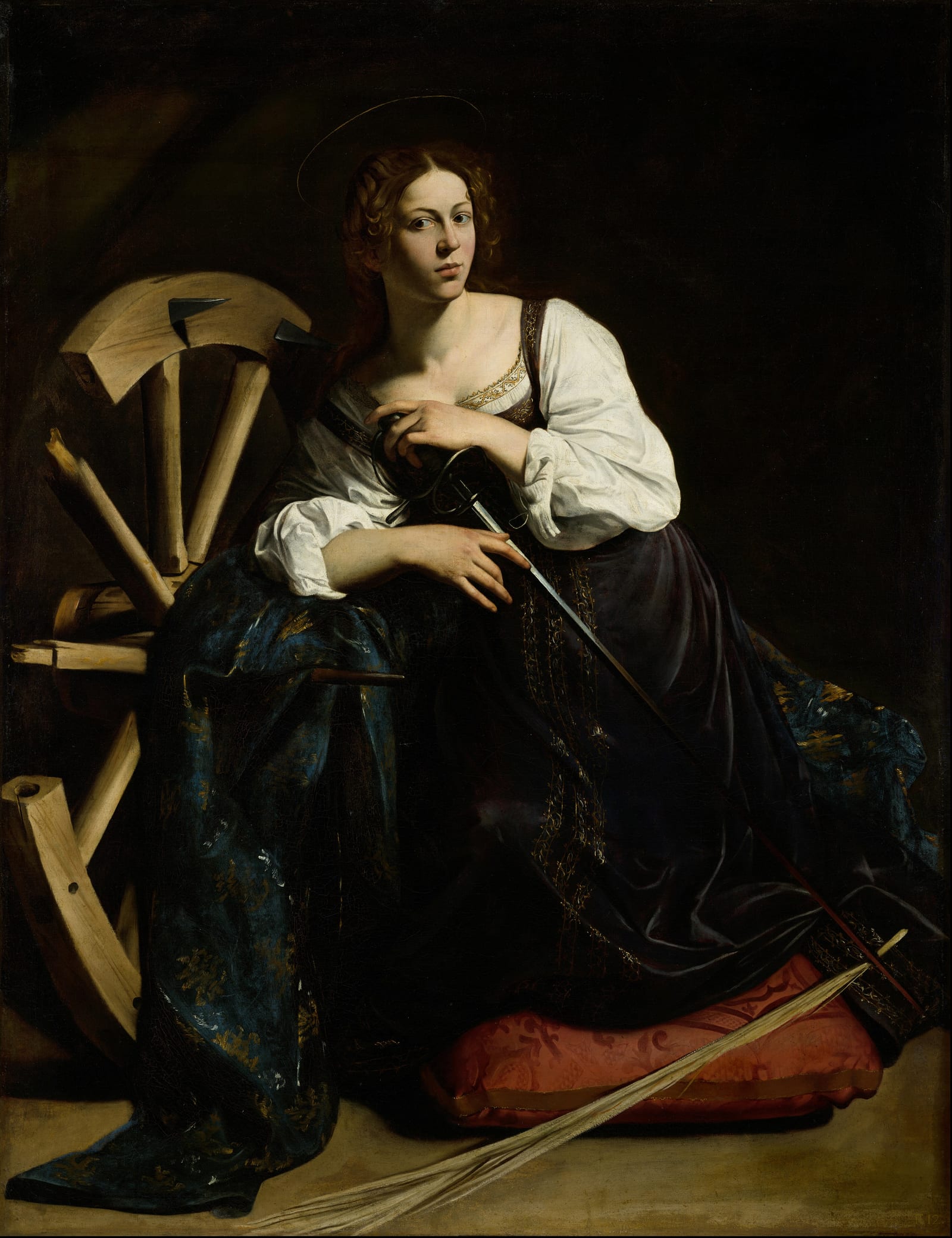
Catherine, by tradition, was the daughter of King Constus of Alexandria, learned in the philosophy and sciences of her age. At eighteen she came to court and rebuked the Emperor Maxentius for his idolatry. He gathered fifty of the greatest pagan philosophers to debate her; she converted them all, and they were burned at the emperor's command.
She was scourged, imprisoned, and subjected to the breaking-wheel — the spiked instrument that has ever since borne her name (the 'Catherine wheel,' both in fireworks and in heraldry). The wheel shattered at her touch, killing the executioners. She was beheaded; her body was carried by angels to the summit of Mount Sinai, where her relics rest today in the Monastery of St. Catherine, the oldest continuously inhabited Christian monastery in the world (548).
Her cult was immensely popular in the medieval west; she was one of the Fourteen Holy Helpers and one of the great university patrons (the University of Paris was dedicated to her). St. Joan of Arc named Catherine as one of the three saints (with Margaret and Michael) who spoke to her.