
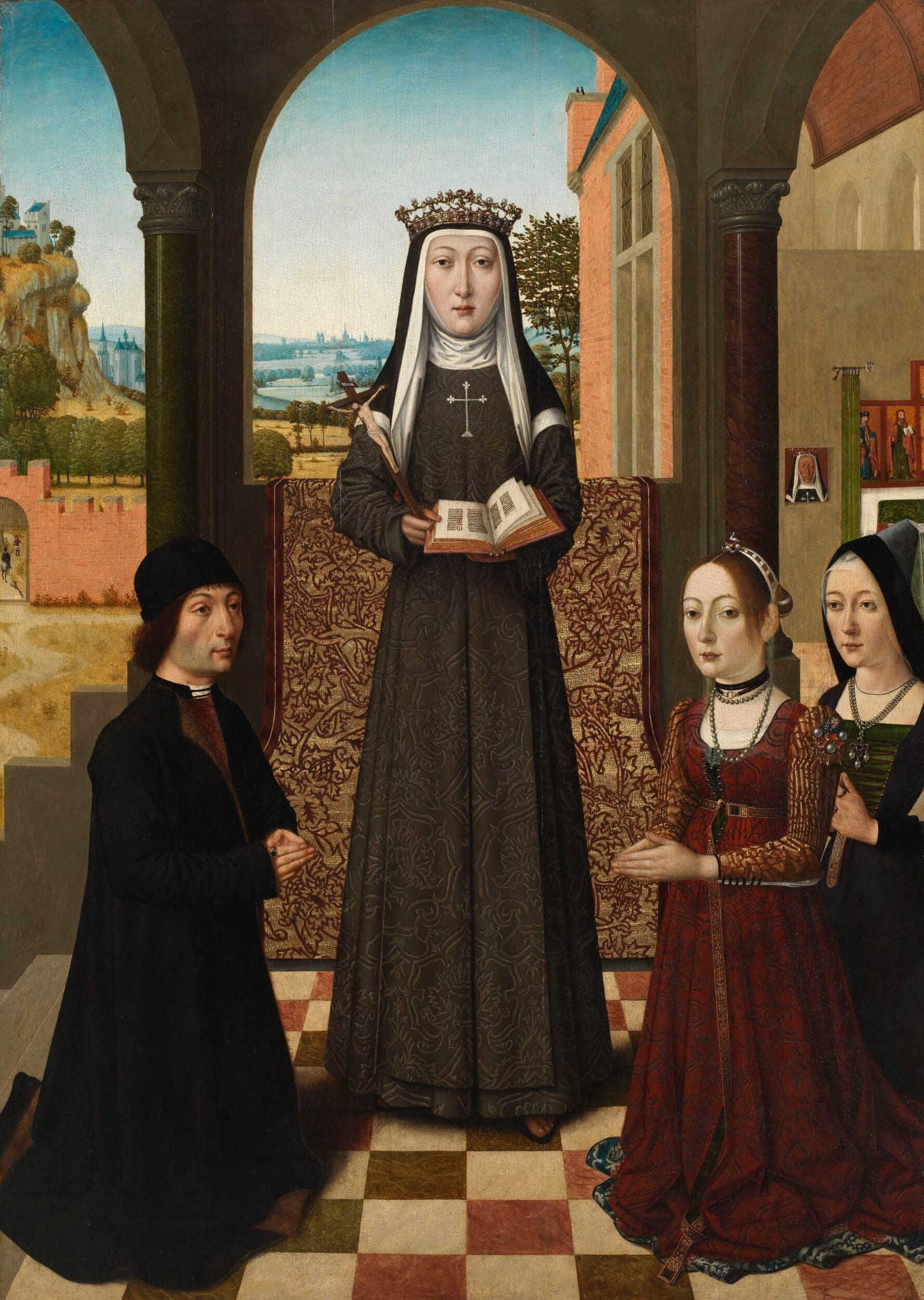
Caterina de' Vigri was born to a noble Bolognese family at the court of the Marquess of Ferrara, where she received an excellent humanist education — Latin, the visual arts, music, and miniature painting. At fourteen she returned to Bologna and shortly after entered a group of Augustinian tertiaries who, under the spiritual guidance of the Franciscan observance, became formal Poor Clares in 1431.
In 1456 she was sent to found the new Corpus Domini Poor Clare convent in Bologna, the city of her birth — a Colettine-line foundation she governed as abbess until her death. She painted icons and devotional miniatures throughout her life (works survive in Bologna and Venice), wrote in Italian and Latin (her Revelations and the treatise The Seven Spiritual Weapons against Temptation — Le sette armi spirituali — are the most accomplished mystical-ascetical works by an Italian Quattrocento woman), and was famous in the city for her direction of penitents and her balance of severe ascesis with humanist learning.
She died at Bologna on March 9, 1463. Her body, never embalmed, was buried in the convent garden — but the next day reports of an unusual fragrance from the grave and unexplained cures attributed to her began. The body was disinterred eighteen days later and found incorrupt, with a posture suggesting she was 'sitting up.' Her sisters placed her seated upright in a chair in a small chapel of the monastery, where she has remained — vested in Poor Clare habit, holding a small wooden cross — for over five and a half centuries. The body is still visible in this exact posture at Corpus Domini in Bologna. Canonized in 1712, declared patroness of artists by Pius XII in 1953.