
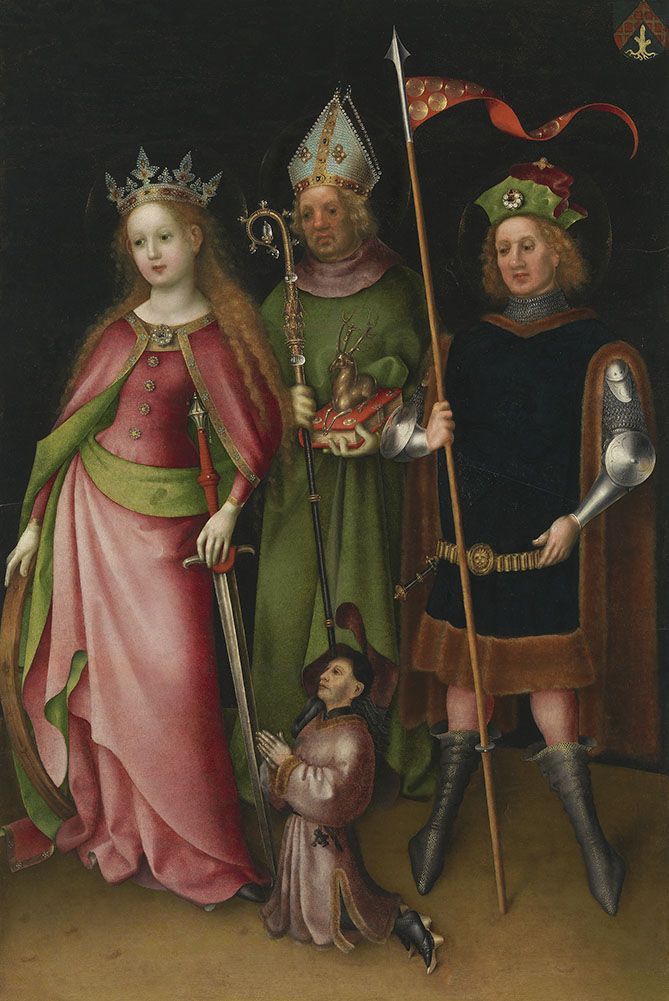
MIRACULOUS MIRACLES™

Saint — Cyriacus the Deacon

St. Cyriacus the Deacon
Late 3rd century, Rome (per tradition, of patrician family) — c. 304 AD, Rome (under the Diocletianic persecution)
Roman Deacon-Martyr — One of the Fourteen Holy Helpers
Catacombs of San Callisto, Via Appia, Rome; major medieval shrine at the Roman church of San Ciriaco in Via Lata, Italy
Feast
August 8
Canonized
Cult of ancient antiquity; one of the Fourteen Holy Helpers (Vierzehnheiligen) of the medieval German tradition
✠ MartyrBeheaded with three companions on the Via Salaria, Rome, c. 304 → The Martyrs
Life

Cyriacus (Greek Kyriakos, 'belonging to the Lord') was — per the late-4th-century Acts of Cyriacus — a wealthy Roman patrician who renounced his fortune to become a deacon of the Roman Catholic Church under Pope Marcellinus (see Marcellinus's entry above) in the early 4th century. He devoted his time and remaining means to working in the Roman quarries — alongside the Christian prisoners who had been sentenced to forced labour during the Diocletianic persecution — and to ministering to them.

Per the legendary tradition (preserved in the medieval Latin Acts), Cyriacus was famously called by the Emperor Diocletian (or his successor) to exorcise the demonic possession of the Emperor's daughter Artemia. After successful exorcism, Diocletian — instead of executing him — sent him on a long journey to the Sassanid Persian court to perform a similar exorcism of the Persian princess (who was likewise possessed). After Cyriacus's successful exorcism of the Persian princess, the Persian king Sapor gave him imperial protection and gifts (a substantial historical-anachronism — the chronology of Sapor I, Sapor II, etc., does not actually align with the date of Cyriacus's martyrdom, but the medieval legendary tradition disregarded this).

Cyriacus returned to Rome after the supposed Persian journey only to find that the persecution had escalated under the new Emperor Maximian. He was arrested with three companions (Largus, Smaragdus, and Crescentian) and beheaded on the Via Salaria around 304 AD. His relics were first venerated at the catacombs along the Via Salaria, later translated to the small Roman church of San Ciriaco in Via Lata, and finally substantial portions translated to the Cathedral of Ancona (which is named for him as joint patron) and to Bamberg in Germany (where his cult became foundational for the medieval German Vierzehnheiligen tradition of the Fourteen Holy Helpers).

Miracles & Phenomena
  • Exorcism of the demonically-possessed princesses

    Cyriacus's exorcism of the Emperor Diocletian's daughter Artemia and (per the legendary tradition) the Persian princess at the Sassanid court — established the foundational medieval Catholic patronage of Cyriacus for sufferers of demonic temptation and oppression.

Relics
  • Body
    Relics of St. Cyriacus
    Cathedral of Ancona (Italy — joint patron); also at the Bamberg Cathedral (Germany — translated 1064)

    Major relics rest at the Cathedral of Ancona — the great Romanesque cathedral on the Adriatic coast — and at the Bamberg Cathedral in Bavaria, translated to Bamberg in 1064 by Emperor Henry III as a foundational relic-treasure for his newly-established Bavarian-imperial church.

Iconography
  • Cyriacus expelling the demon from the princess

    The Roman deacon in dalmatic holding aloft a crucifix and a small palm of martyrdom, the demon-figure visibly fleeing from the kneeling princess at his feet, the small dragon (the standard medieval Catholic symbol of the devil) being pierced by his deacon's stole — the iconography of the Fourteen Holy Helpers.

Prayers to This Saint
Patronages
Sufferers of demonic temptation and oppression (the foundational medieval Catholic patronage)The dying (popular German tradition)Diocese of RomeDiocese of Ancona (his major Italian shrine)Diocese of Cologne (translation of relics)