
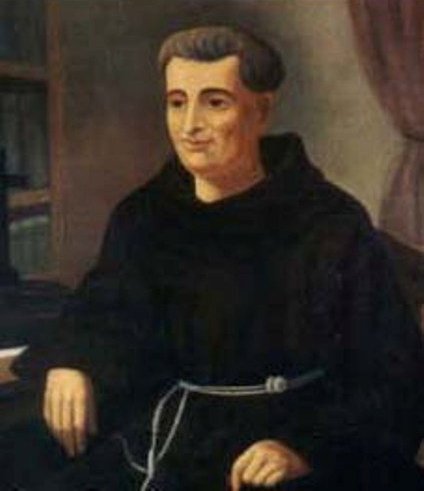
Antônio Galvão de França was born in 1739 at Guaratinguetá, in the captaincy of São Paulo, one of the eleven children of Antônio Galvão de França, a merchant of the Third Order of St. Francis, and Izabel Leite de Barros, who died in 1755 at thirty-eight. At thirteen he was sent to the Jesuit seminary at Belém, in Bahia. On 15 April 1760 he entered the Franciscan novitiate of St. Bonaventure at Macacu, near Rio de Janeiro, made his solemn profession a year later — with the Franciscan vow to defend the title of the Immaculate Conception — and was ordained in 1762 and sent to São Paulo. His consecration to Mary as her 'son and perpetual slave', which both popes quoted at his beatification and canonisation, the Brazilian Franciscans keep as a page he signed in 1766.
As confessor to a house of religious women he came to know Sister Helena Maria of the Holy Spirit, whose visions asked for a new foundation, and on 2 February 1774 they founded the Recolhimento of Our Lady of the Conception of Divine Providence — today the Mosteiro da Luz. The Captain-General of São Paulo had it closed in June 1775; it reopened that August. In 1780 Frei Galvão was sent into exile for defending a soldier whom the Captain-General had condemned to death for a slight offence to his son; the sentence was revoked and he returned. He directed the building of the house and its church, dedicated on 15 August 1802, founded the convent of St. Clare at Sorocaba in 1811, and died at the Recolhimento on 23 December 1822. He was buried in its church.
He is remembered above all for the 'pills' that still bear his name: a line from the Office of Our Lady — 'Post partum, Virgo, inviolata permansisti: Dei Genitrix, intercede pro nobis' — written on a slip of paper and rolled up to be swallowed. By the account the Dicastery gives, he first made one for a young man dying of kidney stones, whose pain ceased, and then for a woman in a hard labour, whose child was born quickly. The sisters of the Mosteiro da Luz still make them by hand and give them away; the Franciscans are plain that they are a devotion, not a medicine, and no reason not to see a doctor.
John Paul II beatified him on 25 October 1998. Benedict XVI, on his visit to Brazil, canonised him on 11 May 2007 at an open-air Mass on the Campo de Marte in São Paulo, before a crowd reported at between 800,000 and 1.2 million, calling him the first Brazilian 'raised to the glory of the altars'.