
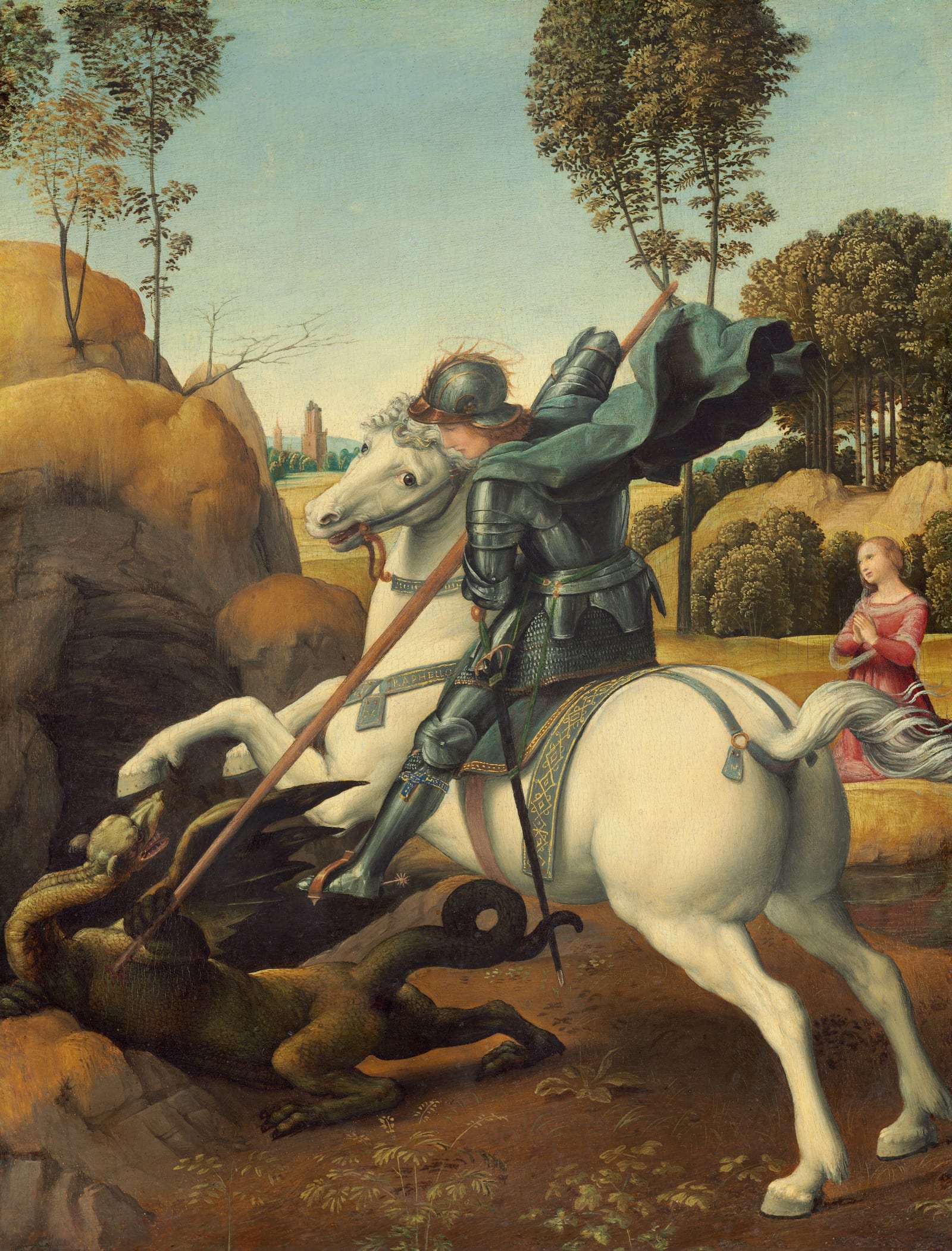
Tradition records George as a Christian officer of the Roman army from a noble Cappadocian family. At the outbreak of the Diocletianic persecution (303), he confessed Christ publicly in the imperial court at Nicomedia, distributed his fortune to the poor, and was subjected to a long sequence of tortures — bound to a wheel of swords, given poison, placed in a cauldron of molten lead — surviving each by miracle. He was finally beheaded on April 23, 303.
His cult spread rapidly: by the 6th century he was venerated across the empire from Britain to Persia. The Eastern Churches name him Megalomartyr ('the Great Martyr'). The Crusaders carried his cult home to western Europe; King Richard I of England named him patron of his army, and Edward III made him patron of the Order of the Garter in 1348. He is the principal patron of England.
The legend of George and the Dragon — recorded in the Golden Legend (c. 1260) — has him as a Cappadocian knight passing through Libya, where a dragon menacing the city of Silene is about to devour the king's daughter. George wounded the dragon with his lance, led it to the city by the princess's belt, and slew it before the people, who all converted to Christ. The story is allegory; the historical core of the cult is the martyrdom at Lydda.