
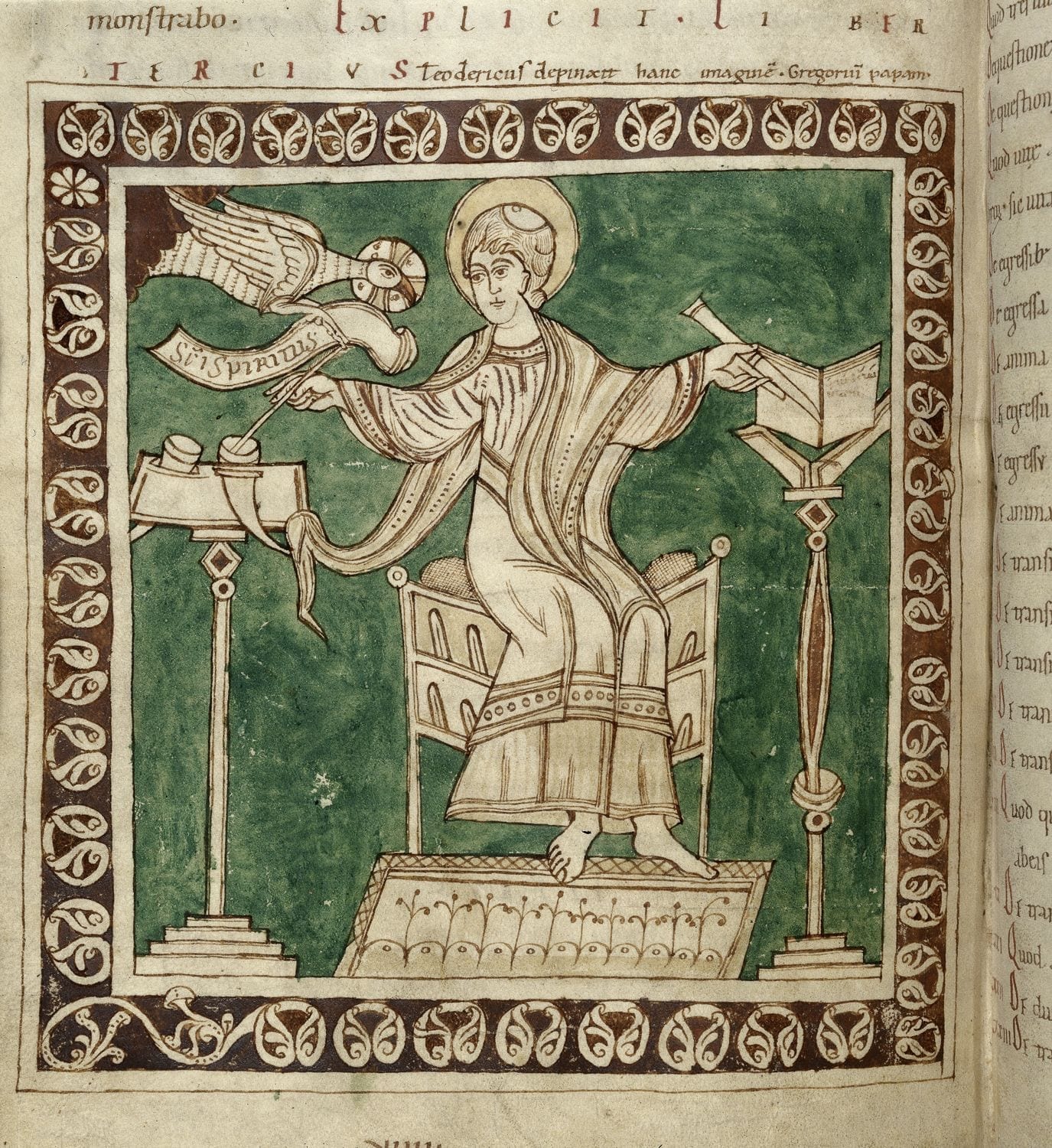
Gregory was born to a wealthy Roman senatorial family with three popes in his ancestry. Trained for the law, he rose to be Prefect of the City of Rome at about thirty — the highest civic office in what remained of the Western empire. Suddenly, in 574, he gave it all up: he sold his vast Sicilian estates to found seven monasteries, turned his family's house on the Caelian Hill into the eighth (San Gregorio al Celio), and took the Benedictine habit himself.
He served as papal legate to Constantinople (579–586), where he learned Greek poorly but observed the imperial Church closely. Returned to Rome, he was Abbot of his own monastery on the Caelian when, in 590, after the plague had killed Pope Pelagius II, the clergy and people elected him pope by acclamation. He resisted, but he was consecrated on September 3, 590.
His fourteen-year pontificate is a foundational moment for the Western Church. He organised relief from his own resources for the Roman poor during the famine that followed the plague. He defended Rome against the Lombards, paying tribute from Church funds when imperial troops failed to come. He sent St. Augustine of Canterbury and forty monks to England in 596, beginning the conversion of the Anglo-Saxons. He systematised the liturgy and the chant that would bear his name (the Gregorian Reform of liturgical music). He wrote the Dialogues (preserving the principal early Life of St. Benedict), the Pastoral Rule (the textbook of the medieval bishop for a thousand years), the great Moralia on the Book of Job, and Homilies. He took, for the first time, the title 'Servant of the Servants of God' — the title every pope has used since.