
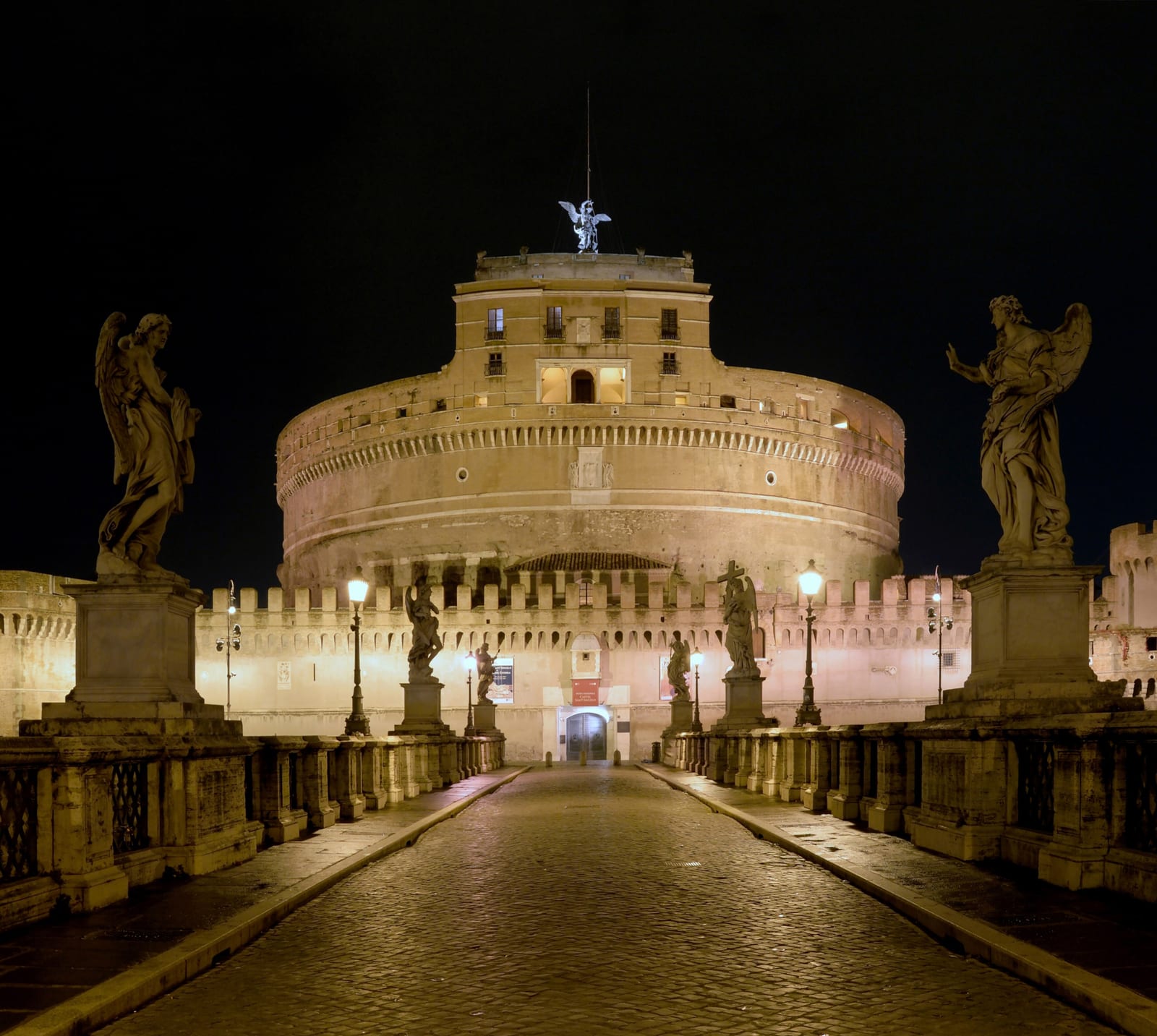
Pope St. Gregory the Great had been elected pope in September 590, in the midst of a catastrophic plague that had killed his predecessor Pelagius II and was decimating the population of Rome. Gregory organised great penitential processions through the city in late 590, the entire population in seven streams converging toward Santa Maria Maggiore.
As Gregory led one of these processions across the Aelian Bridge over the Tiber, he saw atop the great cylindrical mausoleum of the Emperor Hadrian — which dominated the Vatican plain — the figure of the Archangel Michael, sheathing his sword. He understood the vision as the divine sign that the plague had ended. From that day, the mausoleum has been called Castel Sant'Angelo — the Castle of the Holy Angel. The great bronze statue of St. Michael by Peter Anton von Verschaffelt (1752) that still crowns the castle commemorates the vision. Gregory's vision is one of the foundation moments of the medieval cult of St. Michael in the West.