
MIRACULOUS MIRACLES™

Saint — James the Greater

St. James the Greater
early 1st century, Bethsaida or Galilee — AD 44, Jerusalem
Santiago — Patron of Spain
Cathedral of Santiago de Compostela, Spain
Feast
July 25
✠ MartyrKilled with the sword (beheaded) in Jerusalem by Herod Agrippa I, AD 44 → The Martyrs
Life

James, son of Zebedee, was an elder brother of John the Evangelist; with Peter and John he formed the inner circle of three to whom Christ revealed his greatest moments — the raising of Jairus's daughter, the Transfiguration on Tabor, the agony in Gethsemane. Jesus called the brothers 'Boanerges' — Sons of Thunder.

He was the first of the Twelve to be martyred. Acts records that Herod Agrippa I, in his persecution of the Church, 'killed James the brother of John with the sword' (Acts 12:2) — beheading, the Roman form of execution. This martyrdom is the only one of the Twelve recorded in the New Testament itself, dating to around AD 44.

A medieval Spanish tradition, supported by Bishop Theodemir of Iria in the 9th century, holds that James had preached in Spain before his return to Jerusalem and that, after his beheading, his body was carried by his disciples back to the coast of Galicia. His tomb, rediscovered in the early 9th century at Compostela ('field of the star,' according to the legend), became the third great pilgrimage of medieval Christendom — after Jerusalem and Rome.

Miracles & Phenomena
  • At the Transfiguration

    James was one of three apostles taken up Mount Tabor by Christ to witness the Transfiguration — Christ glorified between Moses and Elijah — and one of three taken into Gethsemane on the night of the Passion (Matthew 17; 26).

  • The Translation of the Relics to Compostela

    According to Spanish tradition, after his beheading at Jerusalem his disciples took his body to the coast of Galicia by ship and buried him near Iria Flavia. The grave was lost during the Roman persecutions and rediscovered in the 9th century, marked by a field of stars — Campus Stellae, 'Compostela.'

  • Santiago Matamoros at the Battle of Clavijo

    Spanish tradition (likely later legend) holds that James himself appeared on a white horse at the Battle of Clavijo in 844, leading the Christian forces against the Moors. Hence the title Matamoros ('Moor-slayer') — a controversial title in modern times, no longer used in many devotions.

Relics
  • Body
    Tomb of St. James the Greater
    Crypt of the Cathedral of Santiago de Compostela, Spain

    Beneath the high altar of the cathedral, in a silver reliquary. The site has been a major Christian pilgrimage destination — the Camino de Santiago — for over a thousand years.

  • Bodily relic
    Skull of St. James the Greater
    Cathedral of St. James, Jerusalem (Armenian)

    The Armenian cathedral of St. James in the Old City of Jerusalem honours his martyrdom on its site and claims to possess the relic of his head.

Iconography
  • Santiago Peregrino — the Pilgrim

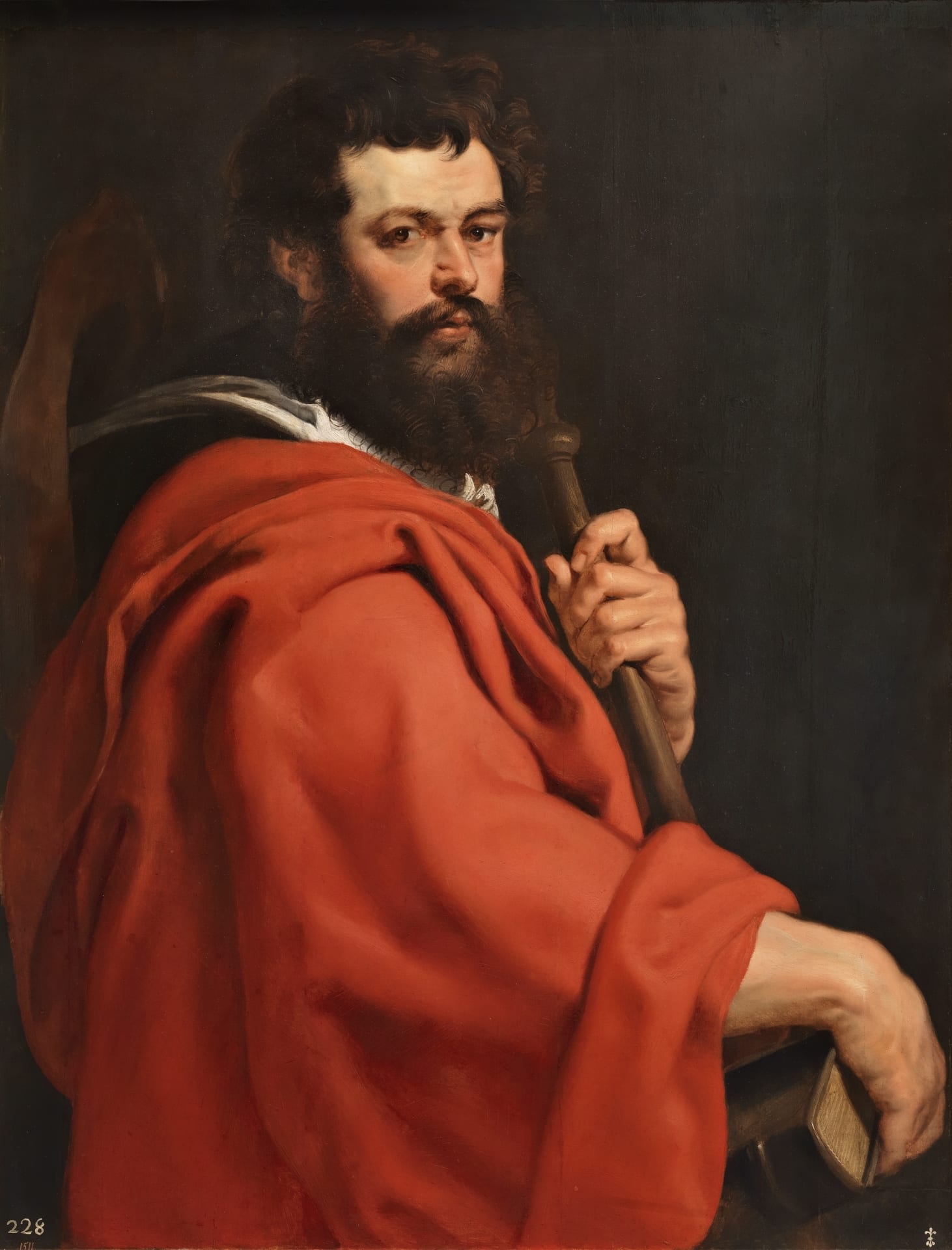
    His defining iconography in Spain — James in a pilgrim's cloak with a broad-brimmed hat, a staff (bordón), a gourd for water, and the scallop shell that became the symbol of every Compostela pilgrim.

  • Santiago Matamoros — the Knight

    A medieval iconographic type showing James on a white horse with a drawn sword — born from the Reconquista; controversial in modern Spain.

Patronages
SpainPilgrimsSoldiersVeterinariansEquestrians
Sources & Further Reading