
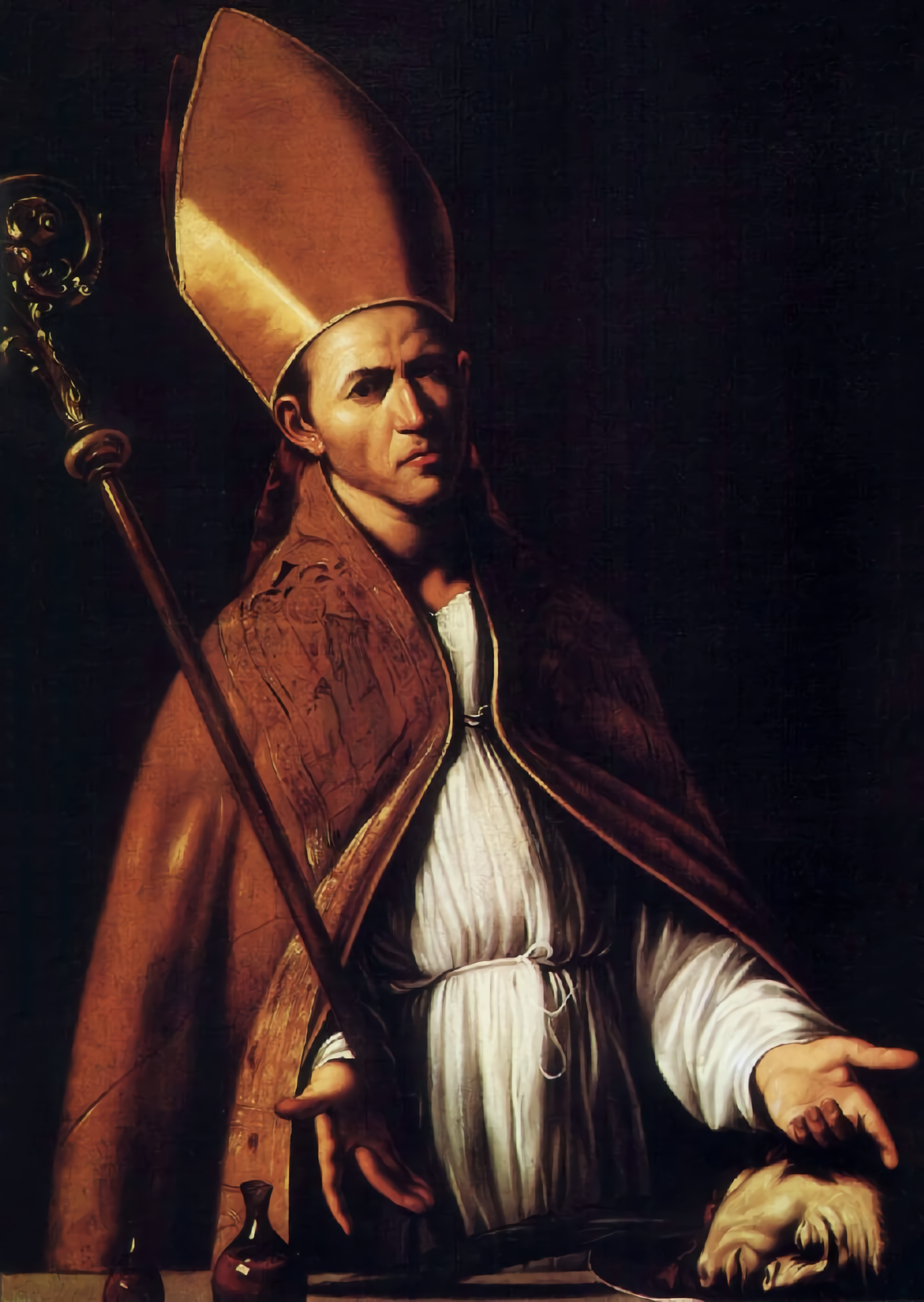
Januarius was bishop of Benevento, and was put to death at Pozzuoli in the Great Persecution, about the year 305, with the deacons Festus, Sosius and Proculus, the lector Desiderius, and the laymen Eutyches and Acutius, who had come to visit him in prison. The passion that tells of the furnace and the wild beasts that would not touch them is late; the martyrdom itself is not doubted, and the calendar keeps him on 19 September.
His body was brought to Naples in the fifth century, carried off to Benevento in 831, to Montevergine in 1154, and home to Naples in 1497, where Cardinal Oliviero Carafa built the Succorpo under the cathedral to hold it. The city vowed him a chapel in 1527, in a year of plague, war and eruption, and the Treasure Chapel that resulted holds the silver-gilt bust of 1305 that contains his skull, and the two ampoules.
The ampoules hold what Naples has always held to be his blood, dried and dark, and on three days of the year, the Saturday before the first Sunday of May, 19 September and 16 December, it is brought out before the people and liquefies, or does not. The first written record is of 17 August 1389. The Church has never pronounced on it: the cult is permitted and the phenomenon is left to God and the chemists, of whom Garlaschelli and his colleagues showed in 1991 that a thixotropic gel of iron compounds available in the Middle Ages behaves the same way. The site's own entry on the liquefaction gives both sides in full. In 1631, when Vesuvius erupted, the relics were carried in procession toward the lava and the city holds that it stopped; he has been the first patron of Naples since.