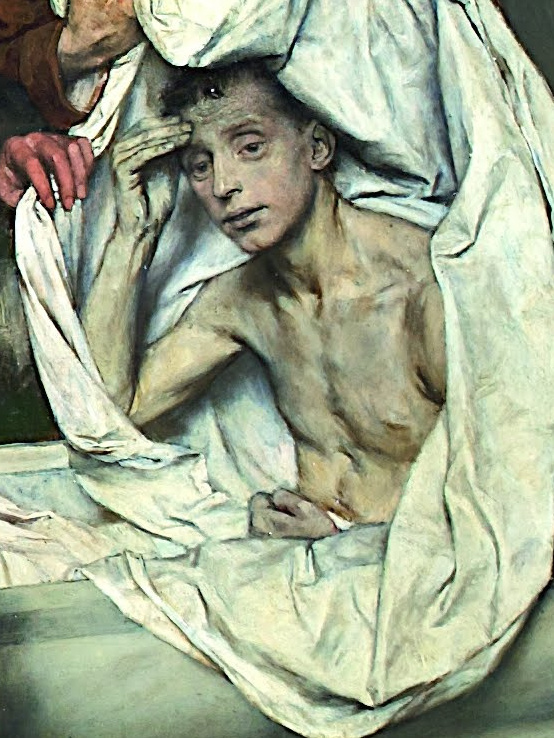
Lazarus of Bethany, brother of Martha and Mary, was a beloved friend of Christ. His name in Hebrew (Eleazar) means 'God has helped.' The Gospel of John (11) records his death in his sisters' presence, and the four-day delay before Christ arrived at Bethany.
At the tomb the Lord wept — the shortest verse in the New Testament: 'Jesus wept' (Jn 11:35). He commanded the stone to be rolled away. Then He cried with a loud voice: 'Lazarus, come forth.' Lazarus came out bound hand and foot with grave clothes, his face covered with a napkin. Christ said: 'Loose him, and let him go.'
The raising of Lazarus, the seventh and greatest 'sign' of John's Gospel, set the chief priests on their final plan to kill both Jesus and Lazarus (Jn 12:9–11). The Gospel says no more of him after the supper at Bethany six days before the Passover, where he sat at table with the Lord (Jn 12:1–2). Two traditions tell the rest. The Eastern one, the older, takes him to Cyprus as bishop of Kition, where his tomb is still shown; it has its own page. The Western one, a Provençal legend of which, says the Catholic Encyclopedia, there is not 'the slightest trace' before the middle of the eleventh century, brings him by boat with his sisters to Marseille as its first bishop.
In 2021 Pope Francis joined him to his sisters in the General Roman Calendar: 29 July became the memorial of Saints Martha, Mary and Lazarus, the day on which the Roman Martyrology already commemorated Mary and Lazarus (decree of the Congregation for Divine Worship, 26 January 2021). Before then the Roman calendar had kept Martha alone.