
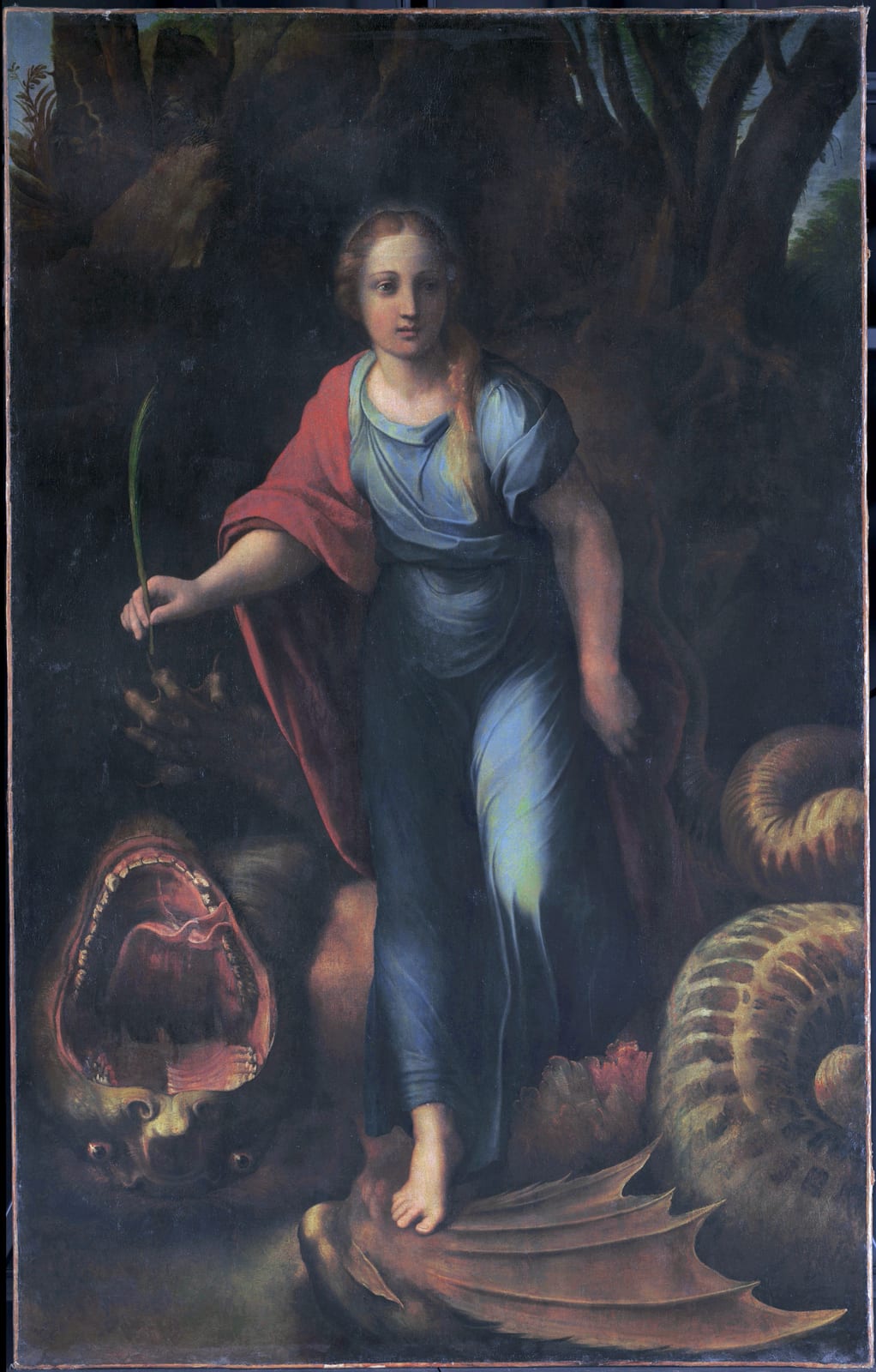
Her acts say that she was the daughter of a pagan priest of Antioch in Pisidia, was turned out of his house for refusing to give up the faith, kept sheep, refused the prefect Olybrius, and was tortured and beheaded in the persecution of Diocletian. The Church has long been candid that the acts are not reliable — the old Roman Martyrology itself flagged them — and she was removed from the general calendar in 1969. The East venerates her as St. Marina and has done since at least the seventh century.
The episode that made her famous is frankly fabulous: Satan came at her in prison in the form of a dragon and swallowed her, and the cross she carried so irritated the beast that it burst and let her out alive. From an escape out of a body came her patronage of women in labour, which is why medieval mothers were given her girdle to hold during a hard birth and why more English churches are dedicated to her than to almost any other virgin martyr.
Whatever the historians conclude about her acts, her place in history is fixed by one witness. At her trial in 1431, asked to name the voices that had spoken to her, Joan of Arc answered: St. Michael, St. Catherine, and St. Margaret.