
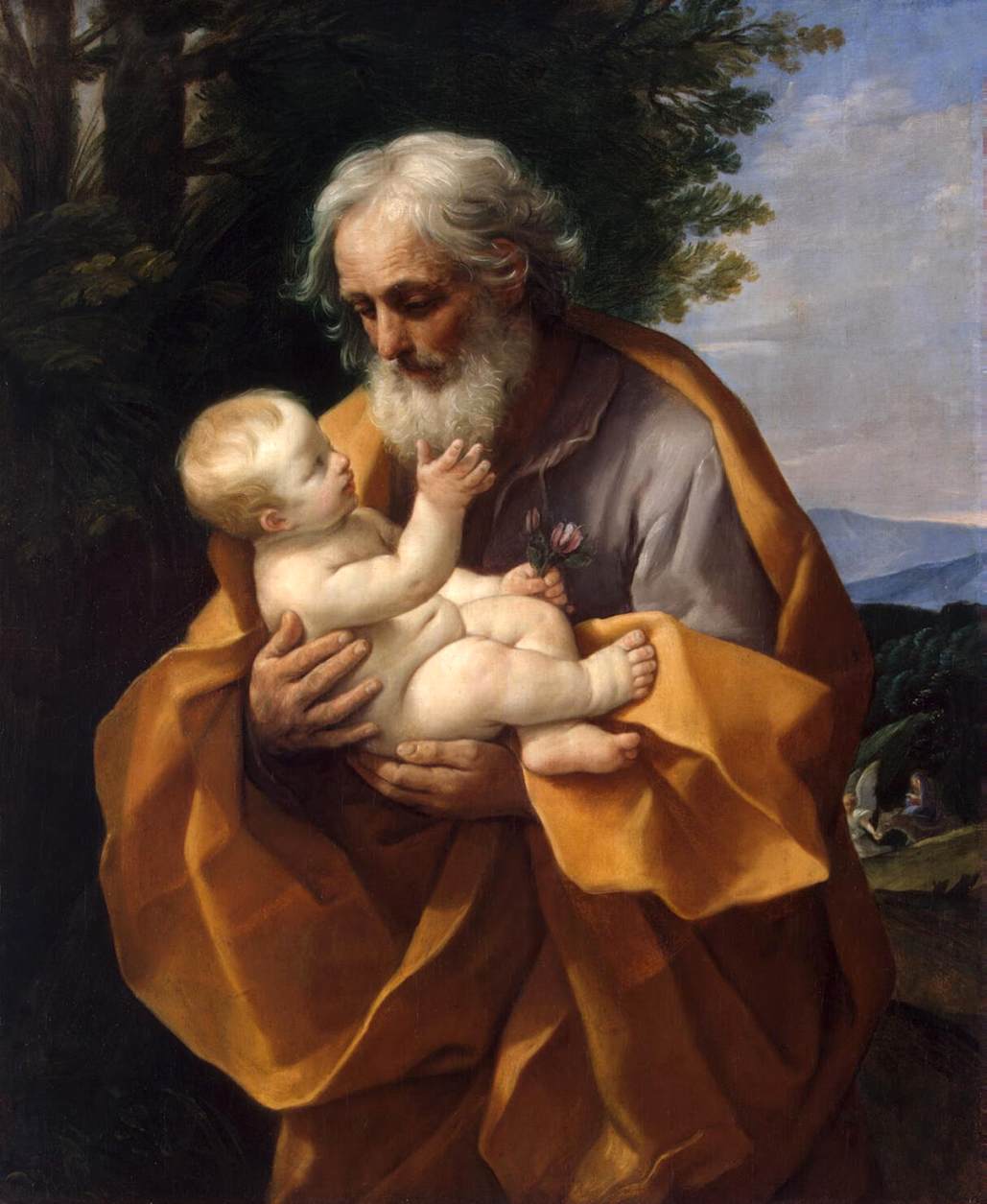
St. Joseph was of the house and lineage of David, a craftsman (tekton, traditionally rendered 'carpenter') of Nazareth. The Gospels of Matthew and Luke record his genealogy, his espousal to the Virgin Mary, his decision to put her away privately upon discovering she was with child, and the angel's instruction in a dream not to fear to take her as his wife (Mt 1:18–25).
He led the Holy Family to Bethlehem for the census, presented the Child in the Temple, fled with them into Egypt at the angel's second warning, and brought them back at the angel's third command to settle at Nazareth. He found the boy Jesus in the Temple at twelve and brought Him back home (Lk 2:41–52).
The Gospels do not record his death; tradition holds he died at Nazareth before the public ministry of Christ, in the arms of Jesus and Mary — the model of a happy death. Bl. Pius IX declared him Patron of the Universal Church in 1870; Pope Francis dedicated 2021 the Year of St. Joseph in the apostolic letter Patris Corde.
His silence in the Gospels is total — not a single word is recorded of him. Yet his obedience, his protection of the Mother and Child, his hidden ordinary work in the carpenter's shop of Nazareth where the Word made flesh grew up — make him, after Mary, the saint most beloved of Catholic devotion.