
MIRACULOUS MIRACLES™

Saint — Thomas Aquinas

St. Thomas Aquinas
c. 1225, Roccasecca — March 7, 1274, Fossanova
Doctor Angelicus — the Angelic Doctor
Church of the Jacobins, Toulouse, France
Feast
January 28
Canonized
July 18, 1323 (by John XXII); Doctor 1567 (by Pius V)
Doctor of the Church
Yes
Life

Thomas was the youngest son of Count Landulf of Aquino, a Lombard noble of the south Italian kingdom. At five he was given as an oblate to the Benedictine monastery of Monte Cassino. At nineteen, against the fierce opposition of his family — they kidnapped him and held him in the family castle for over a year, sending a prostitute to break his vow of chastity (he drove her out with a brand from the fire) — he persisted in entering the new mendicant Order of Preachers.

Sent to study under Albert the Great at Cologne and Paris, the silent and physically heavy young friar (his fellow students called him 'the dumb ox') stunned Albert with the depth of his first lecture. Albert prophesied: 'We call this man a dumb ox, but his bellowing in doctrine will one day resound throughout the world.'

Aquinas spent the rest of his life teaching, preaching, and writing at Paris, Naples, Rome, and Orvieto. He composed the Summa contra Gentiles (1259–65), the Summa Theologiae (begun 1265, unfinished at his death) — a synthesis of Christian doctrine in dialogue with Aristotle and the philosophers of antiquity that no later theologian has equalled — and commentaries on most of Aristotle, on Paul's letters, on Job, on John. He also composed the Office of Corpus Christi at Urban IV's request, including the great hymns Pange lingua, Tantum ergo, Adoro te devote, Lauda Sion, O salutaris hostia.

On December 6, 1273, after celebrating Mass at Naples, he stopped writing forever. Asked why, he answered: 'I cannot, because all that I have written seems like straw to me, compared to what I have seen and what has been revealed to me.' Three months later, journeying to the Council of Lyon, he died at the Cistercian abbey of Fossanova, aged forty-nine.

Miracles & Phenomena
  • The Summa Theologiae (1265–73)

    His unfinished masterwork — over three thousand articles on the whole of Catholic doctrine, structured by question and disputation — has been the central textbook of Catholic theology for seven centuries. Leo XIII in Aeterni Patris (1879) made it the foundation of Catholic philosophical and theological formation. It remains the most cited theological work of the Latin Church.

  • The Office of Corpus Christi (1264)

    Pope Urban IV asked Aquinas to compose the liturgical office for the new feast of Corpus Christi. The result includes hymns — Pange lingua, Tantum ergo, Adoro te devote, Lauda Sion, O salutaris hostia — that have shaped Eucharistic devotion ever since.

  • Mystical Vision at Naples (December 6, 1273)

    December 6, 1273

    While celebrating Mass in the chapel of St. Nicholas at Naples on the morning of December 6, 1273, Thomas received a vision so overwhelming that he abandoned writing for the remaining months of his life. He would say only: 'Mihi videtur ut palea' — 'all I have written seems to me like straw.'

  • Voice from the Crucifix

    An older tradition holds that, praying before a crucifix at Naples, Thomas heard Christ's voice: 'You have written well of me, Thomas. What reward will you have?' Thomas answered: 'Nothing other than yourself, Lord.'

Relics
  • Body
    Tomb of St. Thomas Aquinas
    Church of the Jacobins, Toulouse, France

    His remains were translated from Fossanova to the Dominican Church of the Jacobins in Toulouse on January 28, 1369. After centuries at Saint-Sernin during and after the French Revolution, they were returned to the Jacobins in 1974, where they rest under a marble slab beneath the high altar.

  • Bodily relic
    Head of St. Thomas
    Cathedral of Priverno, Lazio, Italy
  • Bodily relic
    Arm-bone of St. Thomas
    San Domenico Maggiore, Naples (in arm-shaped reliquary)
Iconography
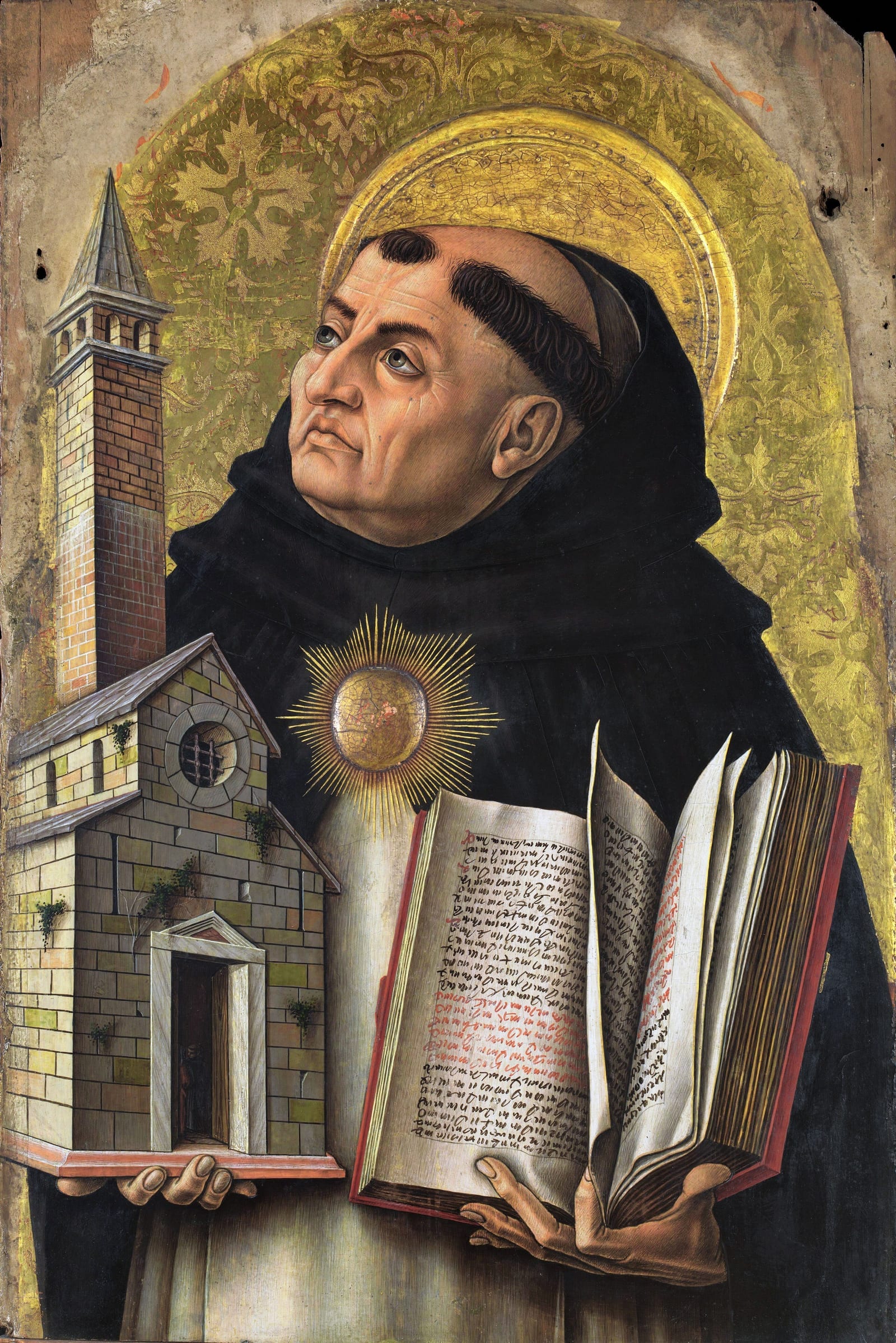
  • St. Thomas with the Sun on His Breast

    His traditional attribute — a sun or radiant disk on his breast, often inscribed VERITAS ('Truth'), with a model of a church in his hand and a quill. The black-and-white Dominican habit is invariable.

  • Apotheosis of St. Thomas
    Benozzo Gozzoli (Louvre); Filippino Lippi (Santa Maria sopra Minerva, Rome)

    A recurring Renaissance and Baroque subject — Thomas enthroned among the Doctors, with Plato and Aristotle giving up their books to him, and the defeated heresiarchs at his feet (Averroes especially).

Prayers Composed by This Saint
Prayers to This Saint
Patronages
Catholic schools, universities, and academiesTheologians and philosophersPencil makers (from his life of writing)Naples
Sources & Further Reading