
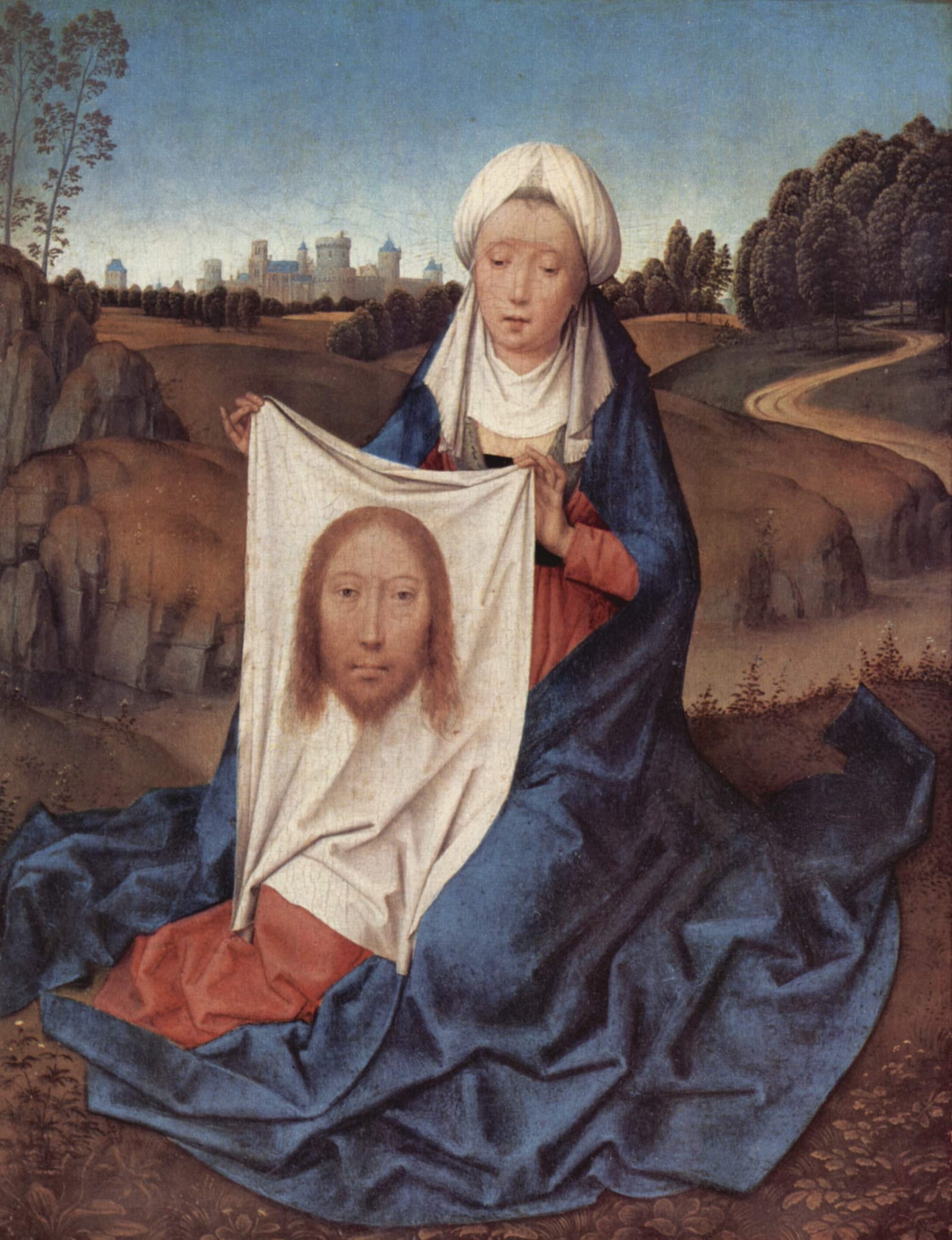
Veronica appears in the medieval Christian tradition — not in the canonical New Testament — as the woman who, moved by compassion as Christ carried his Cross along the Via Dolorosa to Calvary, broke through the crowd to wipe his face with her own veil. The image of his face was miraculously left on the cloth: the Vera Icon (Latin: 'true image'), from which her name (Vera-Icon → Veronica) derives — though some scholars suggest the name precedes the iconographic tradition.
Her story is the foundation of the Sixth Station of the Way of the Cross — the universal Catholic Lenten devotion in fourteen Stations developed by the late medieval Franciscans (see the entry on Leonard of Port Maurice in the 18th-c. catalogue for the systematic 17th–18th-century propagation of the Stations). The Provençal tradition further identifies her as one of the women who, fleeing Jewish persecution in the years after the Resurrection, sailed with Lazarus, Martha, Mary Magdalene, and Mary of Cleophas to Marseille and lived out her life in southern Gaul; she is venerated in the Aquitanian tradition at Soulac-sur-Mer.
The Holy Face cloth known as the Veil of Veronica was preserved at Old St. Peter's in Rome from at least the 8th century, was a major medieval pilgrimage relic of Rome (publicly exposed at Holy Week and at every Jubilee Year), and is preserved today in a chapel-pillar within the dome of the present St. Peter's. A separate tradition surrounds the Veil of Manoppello in the Abruzzi, which since the late 16th century has been venerated as the authentic Veil of Veronica; in 1999 the Jesuit Heinrich Pfeiffer published the still-contested thesis that the Manoppello Veil is the original.