
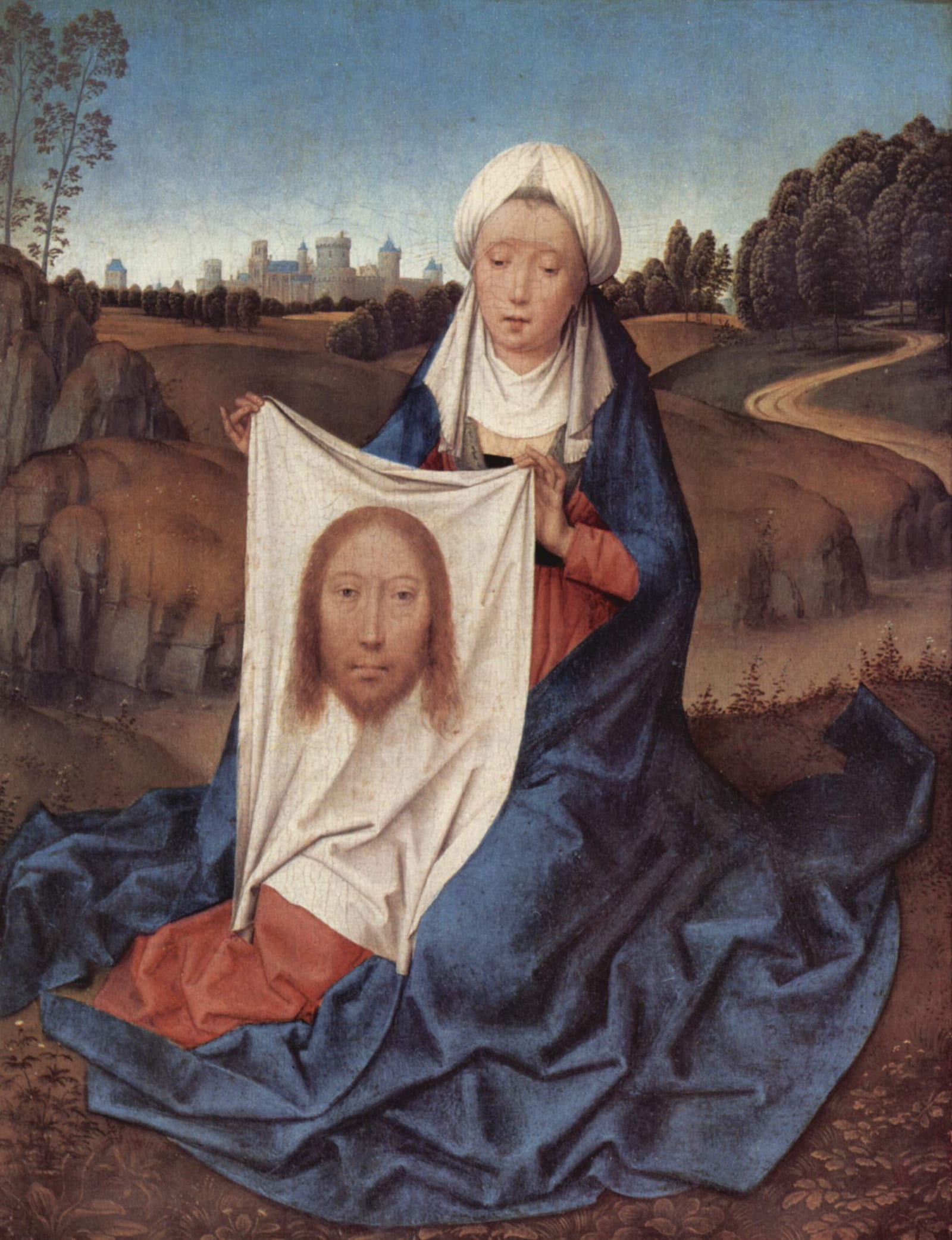
By a tradition first preserved in the 7th–8th-century apocryphal Acts of Pilate and elaborated in the medieval period, a woman of Jerusalem named Veronica wiped the face of Christ on the way to Calvary with her veil — and the imprint of His face was miraculously left upon the cloth (acheiropoieton — 'not made by human hands'). The name 'Veronica' is widely held to derive from vera icon — 'true image.'
A cloth identified as this Veil has been preserved at St. Peter's Basilica in Rome at least since the 11th century, and from 1208 (under Pope Innocent III) was the centre of a vast public veneration: each year on the Sunday after the Feast of the Chair of Peter, the relic was shown to a crowd of pilgrims sometimes numbering hundreds of thousands. The Roman 'Veronica' pilgrimage — combined with the Pilgrimage to the seven basilicas — was, alongside Jerusalem and Santiago, one of the three great medieval pilgrimages.
The Veil's current physical status is the subject of long scholarly debate. The image on the Vatican's relic has faded substantially since the early modern period; some scholars argue that the original was lost during the Sack of Rome (1527) and that what is now venerated is a substitute. The German Jesuit Heinrich Pfeiffer and others have proposed that the original Veil is in fact the Holy Face of Manoppello in the Abruzzo (see the Manoppello entry). The identification remains contested; the Veronica is preserved in the Pier of Veronica at St. Peter's and is exhibited (without close access) on the 5th Sunday of Lent each year.