
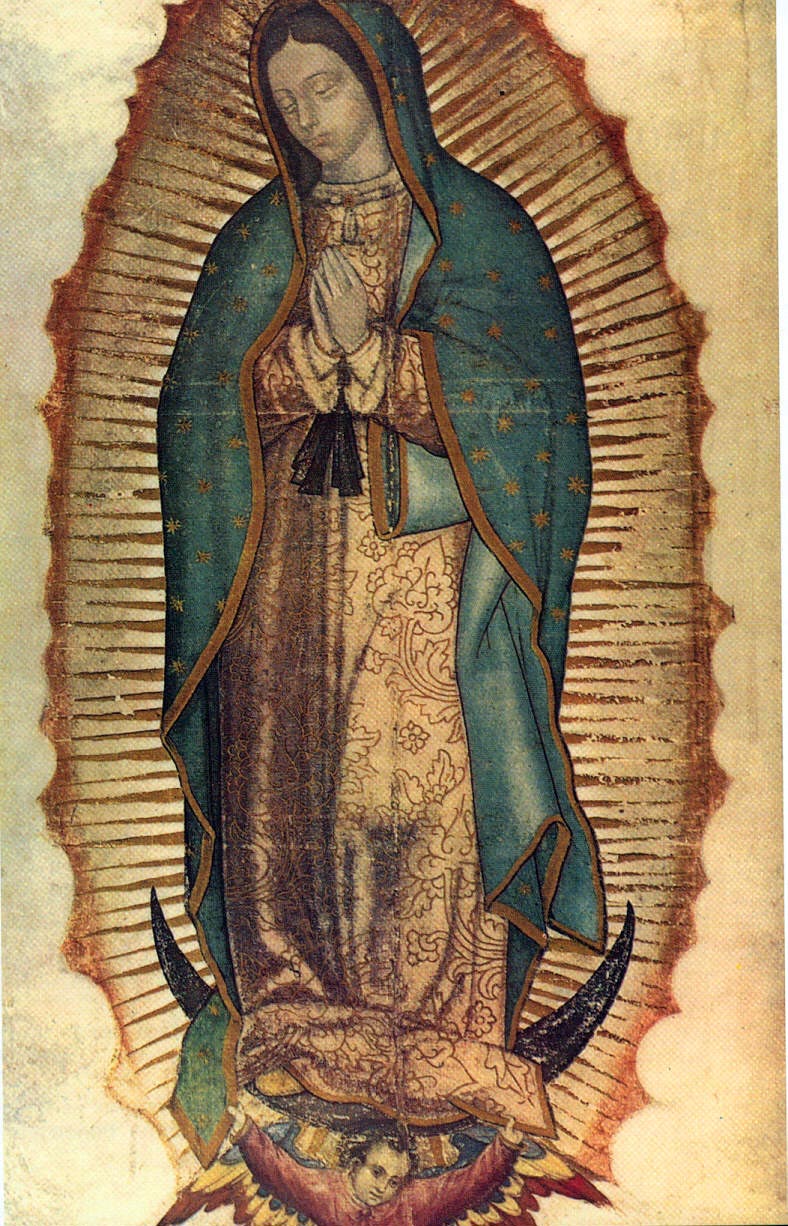
In December 1531, an Indigenous Mexican man named Juan Diego Cuauhtlatoatzin — a recent convert from the Chichimeca people — was crossing Tepeyac Hill on his way to Mass when he heard music and a voice calling him. There he encountered a luminous woman who identified herself as 'the perfect ever-Virgin Holy Mary, Mother of the true God for whom we live,' and asked that a church be built on the site so she might show her love to the people of Mexico.
Juan Diego brought the request to Bishop Juan de Zumárraga, who asked for a sign. After several apparitions, Mary instructed Juan Diego to gather flowers blooming out of season — Castilian roses — on the wintry hilltop. He carried them in his tilma (a coarse cloak woven from cactus fiber) and presented them to the bishop. When he opened the tilma, the roses tumbled out — and there, on the cloak, was the image of the Virgin Mary as she had appeared on Tepeyac.
That tilma, now nearly five hundred years old, has not decayed. Cactus-fiber cloaks of its type normally disintegrate within twenty to forty years. Studies of the image have failed to identify any underlying sketch, any brushstrokes, or any known pigment of organic or mineral origin. The eyes, under magnification, are reported to contain microscopic reflections of figures consistent with those who would have been present at the moment of unveiling.
Devotion to Our Lady of Guadalupe is credited with the conversion of millions of Indigenous Americans in the years following. The Basilica of Guadalupe in Mexico City receives approximately 20 million pilgrims each year, making it the most-visited Marian shrine in the world.