
MIRACULOUS MIRACLES™

Saint — Juan Diego Cuauhtlatoatzin

St. Juan Diego Cuauhtlatoatzin
1474 — May 30, 1548
Visionary of Guadalupe — first Indigenous saint of the Americas
Basilica of Our Lady of Guadalupe, Mexico
Feast
December 9
Canonized
July 31, 2002 (by John Paul II)
Beatified
May 6, 1990 (by John Paul II)
Life

Cuauhtlatoatzin — 'the one who speaks like an eagle' — was born in 1474 in Cuauhtitlán, a town then on the edge of Lake Texcoco. He was of the Chichimeca people, a commoner who owned a small plot of land, married, and lived an ordinary Aztec life until the arrival of the Spanish.

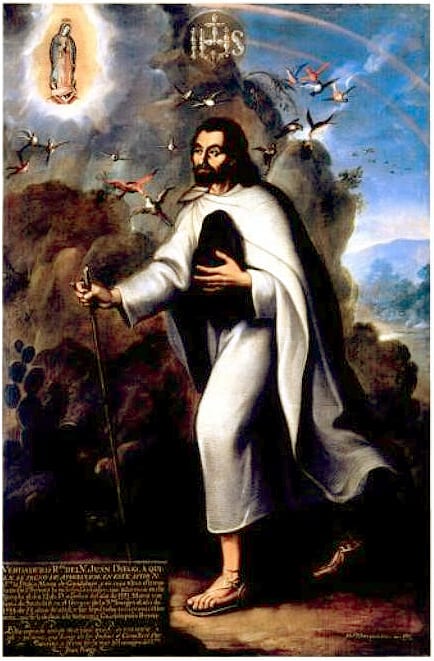
Baptised, probably by the early Franciscan missionaries, around 1524 — taking the name Juan Diego — he walked the long miles into Tlatelolco each weekend for catechesis and Mass. He was already in his late fifties when, on December 9, 1531, he crossed Tepeyac Hill in the dawn cold on his way to instruction.

There he heard music and a voice calling him 'Juan, little one, the smallest of my children.' The Virgin Mary identified herself in Nahuatl and asked that a church be built on the spot. Four apparitions and the miracle of the tilma followed in five days. After the apparitions Juan Diego went to live as a caretaker in a hut next to the first chapel on Tepeyac, where he received pilgrims and told his story for the remaining seventeen years of his life. He died there in 1548.

He was beatified in 1990 and canonised by John Paul II in 2002 — the first Indigenous person of the Americas raised to the altars.

Miracles & Phenomena
  • The Apparitions on Tepeyac

    December 1531

    Between December 9 and 12, 1531, the Virgin Mary appeared four times to Juan Diego on Tepeyac Hill. She identified herself in Nahuatl as the 'perfect ever-Virgin Holy Mary, Mother of the true God for whom we live' and asked that a church be built there.

    → Full miracle page
  • The Image on the Tilma

    When Bishop Zumárraga asked for a sign, Mary directed Juan Diego to gather flowers blooming out of season on the wintry hilltop. He found Castilian roses, carried them in his tilma, and when he opened the cloak before the bishop, the image of the Virgin was found imprinted on it. The tilma is still venerated in the basilica.

  • The Healing of His Uncle Juan Bernardino

    Juan Diego's uncle was dying of cocoliztli (likely a hemorrhagic fever then ravaging Mexico). Mary appeared to him at the moment Juan Diego was bringing the roses to the bishop, healing him and giving him the title under which she wished to be known: Guadalupe.

Relics
  • Object
    The Tilma of Our Lady of Guadalupe
    Basilica of Our Lady of Guadalupe, Mexico City

    Juan Diego's own cactus-fibre cloak bearing the miraculous image. Cloaks of this material normally decompose within 20–40 years; this one is nearly 500 years old.

Iconography
  • The Image of Our Lady of Guadalupe
    Basilica of Our Lady of Guadalupe, Mexico City

    The image on the tilma is itself the great iconographic source: a young pregnant Mary, hands folded in prayer, robed in starry blue and rose, standing on a crescent moon supported by an angel. Every detail carries Nahuatl and Christian symbolism intertwined.

  • Juan Diego Unfolding the Tilma

    Standard devotional image — Juan Diego before the bishop, the roses tumbling out and the image revealed.

Patronages
Indigenous peoplesThe conversion of nationsPilgrims
Sources & Further Reading